Monday, November 30, 2015

Expectant Hope

Yesterday marked the first day of Advent 2015, a day when some light the first candle of five set within a wreath of green.
This first candle, usually purple as befitting the prophecy of a king to come, symbolizes expectant hope. 

"For unto us a child is born, unto us a son is given: and the government shall be upon his shoulder: and his name shall be called Wonderful, Counsellor, The mighty God, The everlasting Father, The Prince of Peace" (Isaiah 9:6). 

I often forget a major reality: Expectancy isn't filled with soft, comfortable days of waiting.


Consider the opening of Jesus' story: an angel comes to Mary, and even after greeting her and letting her know that she's highly favored and the Lord is with her, Mary is greatly troubled. Angel Gabriel has to say: "Don't be afraid." 

No wonder! We've made angels into cute little beings, or, like Henry Payne's section of painting* above, of equal stature. Bernini did a better job of capturing the immensity of angels. 


I like what is comfortable and familiar. Prophecies and hopes are exciting as long as I can wrap them up in a box with pretty wrappings and bows. But, when they don't fit inside of my small comfortable expectations, or when I have to wait, confused and unsure, then I need a reminder that the Lord also says to me as He had Gabriel say to Mary: The Lord is with you. Don't be afraid." 

"Let your conversation be without covetousness; and be content with such things as you have: for He has said, 'I will never leave you, nor forsake you' so that we may boldly say, 'The Lord is my helper, and I will not fear what man shall do to me'" (Hebrews 13:5,6). 

"The Lord has not given us the spirit of fear, but of strength, and of love, and of a sound mind" (2 Timothy 1:7). 

"Nothing...shall separate us from the love of God, which is in Christ Jesus our Lord" (Romans 8:39). 

* "Annunciation" detail from Peace and Goodwill 1921-1922 by Henry Payne, stained and painted glass, leaded in the Birmingham Museums and Art Gallery.

Monday, November 16, 2015

Choosing to be Intentionally Kind

In view of all the bombings last week, I am taken by these sentences by Dallas Willard in his first chapter of The Divine Conspiracy

"Yet, in the gloom a light glimmers and glows. We have received an invitation. We are invited to make a pilgrimage -- into the heart and life of God." 

And, I've been thinking of the words that follow up the two sentences up above: "The major problem with the invitation now is precisely overfamiliarity. Familiarity breeds unfamiliarity -- unsuspected familiarity, and then contempt" (11). 

Many of us reading these words "know" about Jesus, hear about Jesus, see the name of Jesus often, especially during the winter season. As Dallas writes, we "think [we] have heard the invitation...accepted it...or rejected it." 

But, truly "the difficulty today is to hear it at all" (ibid). What is meant by these words of Willard's? I looked up "contempt." Many would be aghast to have anyone say that they have "contempt" for Jesus. Some do live by the first definition of the word: "the feeling that a person or thing is beneath consideration, worthless, or deserving scorn" (computer dictionary), but we wouldn't put ourselves in that category.  

If we think that removes us from having contempt, consider the second definition: "disregard for something that should be taken into account." This is where I think those of us most "familiar" with Jesus fall into "contempt." We so think we "know" Jesus that we have disregard for something that should be taken into account, and that something is how Jesus would live our lives if he were us. When we consider His kindness, love, graciousness, intellect, patience, and more, do we really think He would get bent out of shape (for purposes of translation: angry, mean, insulted and insulting) just because the culture around us doesn't say, "Merry Christmas"? 


The meaning of the greeting above comes from a slurring (common with language) of two words: Christ's Mass. But, the meaning of "Happy Holidays" also comes from a slurring of two Christ-centered words: Holy Days. 


Frankly, I can say, "Season's Greetings" and absolutely be following Christ in that moment or I can say, "Merry Christmas" and be far, far away from the heart and life of God. 


Lest, anyone think that I have failed to keep Christ in his proper place of December (January for my Russian friends) by posting about Christmas before we have had Thanksgiving (which is only a November holiday for the U.S.), I am THANKFUL that Jesus cares more about my heart and soul attitude and actions than He does about whether I plaster His name everywhere. You know, if He were me, He might even use the money I typically spend in Christmas cards and specialty coffee drinks and instead practice intentional kindness and helping out those in need.  

Thursday, November 12, 2015

Ugh. I Missed a Special Moment

This week I had one of those ironic life moments. I was so busy "enhancing" a picture of God's creation (the photo below) by adding a scripture verse that I missed His handiwork right in my own yard: a deer with a fawn that I saw running off (after I decided a picture of God's creation was beautiful enough without a verse on it)! Many verses could go with this picture, or it could point back to the Creator Himself.


I like beautiful pictures with verses on them, and I don't necessarily think a picture with a verse is what Dallas Willard had in mind when he wrote about "clothing and greeting card graffiti" or "be cute or die" (The Divine Conspiracy 10), but go into a Christian bookstore and verses on anything and everything are certainly commercial products. Those products can be great reminders of God's words to us, but I was so busy trying to do something for God that I missed just being with Him in His creation and seeing His handiwork. And, if I am going to be transparent, maybe my picture idea wasn't cutesy, but I'm just as guilty as the next person at striving for cuteness in my Facebook posts!

I'm thankful for both Dallas's gracious words: "Absurdity and cuteness are fine to chuckle over and perhaps to muse upon" AND his exhortation: "But they are no place to live. They [absurdity and cuteness] provide no shelter or direction for being human" (ibid 11).

"Yet, in the gloom a light glimmers and glows. We have received an invitation. We are invited to make a pilgrimage -- into the heart and life of God" (ibid).

This week I was looking at journal prompts and I chose one where we write about 3 brights. The prompt fits well with Willard's quote above and looking for God in His creation (see also Romans 1:20). I wanted three bright things that anyone anywhere could see God in. The first is water as above. For the second, I chose flowers. Even in the most dismal of places, flowers show up.


Thirdly, I chose a child's face. Many, many years ago, I heard of a Russian scientist who came to believe in God as he looked at his child's ear. The ear is so intricately made as are all the parts of us! The eye amazes me with the number of colors that can be seen. Truly "we are fearfully and wonderfully made."


I don't have to miss work or be lazy in order to slow down long enough to be present to what is in front of my eyes. I can stop filling my calendar so full that there is no time to rest. I can look up, see the deer, see the bright beauty of water, flowers, a child's face -- to see God in His creation and worship Him.

I invite you to join me on this pilgrimage "into the heart and life of God." I'm looking for Him in His creation.

If you're a reader and joining me on this slow reading adventure, I moving on to pages 13-17 of The Divine Conspiracy. 

Monday, November 09, 2015

What's IS That Noise?

What is that racket, that commotion, that noise, I hear?

A) the running commentary and video in my head
B) traffic, Internet video clips, radio, podcasts, phone beeps
C) slogans and messages on billboards, clothing, bumper stickers, and everywhere else
D) All of the above

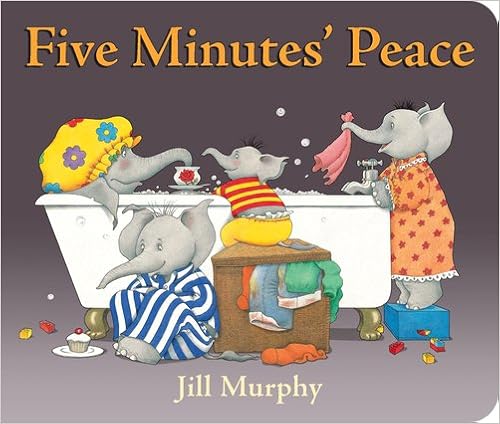
If you're like me, the answer is 'D' -- all of the above. When I lose my keys, the Internet is down at work, the latest text message carries with it a downturn in a friend or family member's health, and social media is broadcasting the latest in who is angry at whom, I feel like the momma elephant in the children's book Five Minutes Peace by Jill Murphy.


"The children were having breakfast. This was not a pleasant sight."

Murphy has this one right. I'm in the middle of reading a book Behind the Beautiful Forevers by Katherine Boo. It's a non-fiction story about life in a Mumbai undercity. Children are not having breakfast there, but they're not really considered the poor in India which makes me wonder how desperate do you have to be to be poor in India. In the meantime, down the street, folks are upset because a major coffeehouse has changed the design of their cups.

The children of the world are having (or not having) breakfast, and it is not a pleasant sight.

During all this morning hour, as in Murphy's book, everyone is vying for momma's or our attention: Look at me! Look at me! Look at me! Then, Can I? Can I? Can I? And, I'll add during this season: Buy me...Buy me...Buy me...

Dallas Willard writes: "We are immersed in birth-to-death and wall-to-wall 'noise' -- silent and not so silent" (The Divine Conspiracy 9). It's not just the morning hour, 24/7 we are "smothered in slogans" (ibid) and facing our own video thoughts.

All the momma wants in this children's book is five minutes of peace, and along with slowing down, five minutes of silence filled with peace helps me and others bring "truth, goodness, strength, and beauty into our lives" (Willard 10). Five minutes of stillness with God cuts through my first instinct to blame someone for "accidentally" picking up my keys (when I simply put them in a different place), cuts through the panic of how will I get my job done, cuts through the despair, cuts through sheer nonsense. God comes alongside and I stop scapegoating (blaming others), and I gain creativity and hope and wisdom. I can lift up my eyes and see someone else at the breakfast table other than myself. That will be the subject of a different post, but for now, for those who might be scared about 5 minutes with God, I leave you with this: God likes you; He loves you. He's like Mr. Rogers except hundreds upon hundreds times better.


Joining me on this journey of practice? Slowing down and 5 minutes of stillness with God.
Joining me reading? Pages 9 - 13 of The Divine Conspiracy. 


Friday, November 06, 2015

Learning Not to Blame Others -- RIP Rene Girard

Yesterday, my post wished Jeffrey Sachs a "Happy Birthday." Today's post wishes Rene Girard a peaceful rest. 


A college professor (at a state university) first introduced me to the writings of Girard. Although I was a Christ-follower, I didn't realize the lie in my life when it came to blaming others. The truth is this: because of Christ, I no longer need a scapegoat; I no longer need to blame others ("not as though I have attained"). Rene Girard taught me that. 

Girard had academic acclaim but his ideas proved problematic for some of his intellectual colleagues when he put his trust in Jesus Christ. For his critics, "One can only know about such theories and principles, and think about them in more or less clever ways," as Willard writes of "the current world of accepted knowledge" in The Divine Conspiracy (5). In today's culture, one shouldn't tie such theories to moral knowledge or God. 

But, according to those close to Girard, he not only taught what he believed, he lived into it as well. 


"René taught us that to truly live is to stop scapegoating our enemies, and to stop justifying it in the name of God. Once at a conference, René was asked what would happen if mimetic theory became wildly successful. He answered, “There would be no more scapegoating.”
To end scapegoating and to truly live we need to follow Jesus by turning away from violence and turning toward our neighbors, including those we call our enemies, in the spirit of love and nonviolence.
René not only taught us that truth, he lived into it. I met him once at a conference for young Girardian scholars. I was struck by the fact that René wasn’t interested in teaching us, or making sure we had his theory “right.” What he wanted more than anything was to talk with us. He wanted to learn about our lives and what interested us. He had a special humility about him – instead of taking glory for himself, he gave glory to others" (Adam Ericksen).

I don't have that special humility but I am on the slow track of practicing Christ-centered spiritual formation. To do so, this week, I'm practicing slowing down -- slowing down enough to let the Holy Spirit get a word in edge-wise when I'm about to scapegoat someone, to blame others. Join me if you care to do so. 

And, if you're a reader, I'm moving on to pages 3-8 in The Divine Conspiracy. 
If you REALLY like to read, here are some links to recent articles on Rene Girard: 
http://www.patheos.com/blogs/teachingnonviolentatonement/2015/11/in-memory-of-rene-girard-the-truth-about-life-and-death/

http://www.patheos.com/blogs/cosmostheinlost/2015/11/04/lux-aeterna-rene-girard-december-25-1923-nov-4-2015/

http://www.abc.net.au/religion/articles/2015/11/05/4346211.htm


Thursday, November 05, 2015

Happy Birthday, Jeffrey Sachs

I changed my mind about what I was going to write this morning when I read that today is Jeffrey Sachs's birthday (11/5/54). You may not know who he is. Don't feel bad; neither did I (and the rest of you can be aghast that we do not know the man considered to be the world's leading expert on economic development and the fight against poverty). 


That's okay. I may not know something that perhaps I should have known, but I'm happy to learn it now. I came across a speech Sachs gave this year at Columbia University (3/30/2015) when I did an Internet search for moral knowledge in U.S. universities. I was sure that Dallas Willard's information in his opening chapter of The Divine Conspiracy must have changed since 1997. After all, Willard cites Derek Bok's 1986-1987 "President's Report" (for Harvard). Bok concludes his report with this remark, "Despite the importance of moral development to the individual student and society, one cannot say that higher education has demonstrated a deep concern for the problem..." (qtd. by Willard 3). 

I know I promised to try to be brief. (I'm working on it.) The title of Sachs's speech was "What is a Moral University in the 21st Century?" and you can probably guess that Willard's information still holds true. Sachs acknowledges early on in his speech, "There are many who, quite understandably, would argue that we shouldn't enter the moral thicket." Many of my friends would look at me wondering why I would be surprised: Of course universities aren't involved with moral education anymore. But, read what Sachs said next: "Let's be pragmatic, they would say." Ohhhhh, there's quite a few of us that tend toward pragmatism. Let's be practical, we say. 

Later Sachs says, "Almost all of us are out of practice in moral reasoning. Moral reasoning...requires training, practice, and experience...We are mostly out of practice..." And, he concludes: "My message, colleagues, is that morality counts. It counts for our intellectual purposes; it counts for our souls." 

I can hear friends now: "Whose morality?" Sachs mentions Buddha, Aristotle and Jesus. I'm going with Jesus. As, I mentioned a couple of days ago, for many that requires "a fresh hearing for Jesus" free of the "stranglehold...that automatically shunts aside Jesus" (Willard, introduction).

I'm reading The Divine Conspiracy Chapter 1, "Entering the Eternal Kind of Life Now" -- sections "Life in the Dark" and "Rumors from the Intellectual Heights" 

I'm practicing slowing my steps down 1) so that I'm not rushing like a rat in a rat race and 2) so I can hopefully notice if I'm responding to moments in my day the way the world responds: practical, on the defense, watching out for myself, or if I'm responding in the love, goodness, and intelligence of Jesus.  

A link to Jeffrey Sachs's speech: http://jeffsachs.org/2015/04/2748/

Wednesday, November 04, 2015

How Does This Work? Love.

Yesterday's post ended with something for us to consider as we went about our day: Is Jesus relevant to whatever we're doing or going through at the moment we ask the question? Here's one way it worked for me.


On November 1, a major coffeehouse sent me an email letting me know that my favorite time-of-the-year coffee would be available as a free sample on November 2 between the hours of x and y. (All my math friends, I really think you should give me a high-five for whatever it was that I just did there.) However, when I went to my local coffeehouse on November 2, there were no samples. Not a single one. I was tempted to tweet, post, and message my displeasure, but I remembered that I was asking myself if Jesus was relevant to my real life.

In my head I'm playing a running commentary with video: "Oh, boohoo, you didn't get your free coffee sample. How first-world 'poor me' problem is that?" If you thought that along with me, you're right. So before I come back to Jesus and coffee, let me make a few comments about this journey.

1) I presume that you are part of the 40% of the world with Internet connections. That doesn't necessarily mean that you are wealthy as I have met people who due to devastating circumstances are in homeless shelters, and they made sure to keep their computers so that they could find jobs (or have access to their jobs). But, it does mean you are not part of the 60% without, and my examples will probably be familiar to you.

2) In college I read these words in "The Unknown Masterpiece" by Honore de Balzac: "...Gillette, who almost forgave him for sacrificing her to the art of painting..." (italics mine), and I decided I wouldn't sacrifice relationships for the sake of writing. When appropriate, I will share deeper than petty annoyances, but, in reality, it's the day-to-day responses to petty annoyances that build up how we respond when life's tragedies hit us. (More on this in another post.)

Therefore, when I thought about "how to do what he [Jesus] said was best" (Willard, Divine Conspiracy), Jesus said love was best.

"Jesus said unto him [the lawyer who had asked about the greatest commandment in the law], "Thou shall love the Lord your God with all your heart, and with all your should, and with all your mind. This is the first and great commandment. And the second is like it, You shall love your neighbor as yourself. On these two commandments hang all the law and the prophets" (Matthew 22:37-40, underlining mine).

If you're reading: We're still reading the introduction to The Divine Conspiracy.
If you're practicing: We're still exploring -- what does Jesus have to do with this moment? 

Tuesday, November 03, 2015

What's Jesus Got to Do with It?

"My hope is to gain a fresh hearing for Jesus, especially among those who believe they already understand him" -- so begins Dallas Willard in his introduction to his book The Divine Conspiracy. Even Dallas laughed when people kidded him about the book being the most bought unread book on Christian bookshelves. I happen to like the book, but I'm not going to try to talk you into a "fresh hearing" for DC by DW, "especially among those who believe they" can't possibly understand him (to borrow a few of Dallas's words). The book happened to be the first one assigned during a two-year Christ-centered spiritual formation program. I'm a reader and even for me the two years was packed solid and fast track. I want to go back, slow down, and invite those interested to take the journey with me.


"Very few people today find Jesus interesting as a person or of vital relevance to their actual lives...And frankly, he is not taken to be a person of much ability" (DW introduction).


"He is automatically seen as a more or less magical figure -- a pawn, or possibly a knight or a bishop, in some religious game -- who fits only within the categories of dogma and of law. Dogma is what you have to believe, whether you believe it or not. And law is what you must do, whether it is good for you or not. What we have to believe or do now, by contrast, is real life, bursting with interesting, frightening and relevant things and people" (ibid).


"Now, in fact, Jesus and his words have never belonged to the categories of dogma or law, and to read them as if they did is simply to miss them" (ibid).

So, basically, most of us don't think Jesus has anything to do with every day -- REAL -- life. But, what if he does? What if he's actually brilliant, and here, and loves us?

* If you ARE a reader and want to SLOWLY read along the way: Start with the introduction to The Divine Conspiracy by Dallas Willard.

Not a reader? Not a problem. Readers are NOT holier than thou (even though some may think they are...oops, well, I did say I was on the slow track to spiritual formation).

* Something to practice: As we go about our "interesting," "frightening," and "real" life, be open to the possibility that Jesus might actually be relevant to us in that moment.  

Monday, November 02, 2015

I Begin Yet Again for the 3rd? 4th? Time

I've used this title before "I Begin Again." It's an appropriate title for continuing to write after close to two years of silence. It's also an appropriate title for explaining the work of Christ-centered spiritual formation. Each morning (not just for the third or fourth time, but again and again and again), I begin again.


And, God meets me, right where I am. Today, as I was struggling to begin again, forgetting much of what I had learned about how to set up a blog and working with a computer that needs to be updated fully, I had given up being able to find and upload an image of "His mercies are new every morning." I had decided to skip the image (and leave off writing) but to check out the blogs I recommend on my page. There on Learning Along the Way Coaching's post from yesterday -- "Finish Well"-- was this image. God used Lisa Lewis's finishing well on her 31 days of blogging to encourage me as I strive to begin yet again.

You might have had a bad day yesterday, this past week...month...year...you might be in the midst of a struggle this minute. Begin again...and again...and again. As I begin writing again, I hope to explore what Christ-centered spiritual formation looks like -- on the slow track. And, I hope to keep it short (yes, I know, you'll believe it when you see it).


Tuesday, January 14, 2014

Zuppa Tuscana and Play Time Make For a Good Day!

This is my "Plans Went Awry" Font. You probably didn't realize I change fonts for each of the days: Times for Contemplation; Verdana for Wholeness, etc. I'm using Trebuchet for when my plans for the day don't work out. I confess that I can't really tell the difference between Verdana and Trebuchet except that Trebuchet seems a little smaller. On the other hand, I can tell the difference between a day filled with stress and a day when I am flexible. 

I started on Part II of Conquering Anger early this morning, but I didn't finish it. I thought I would continue writing later in the day. In the past, I would have pushed on through getting angry at anyone who or anything that blocked my path. For what purpose? What was the use of accomplishing something if no one wanted to share in the joy of the accomplishment? 

Instead, today, I went to my tutoring job, came back up the hill to pick up my granddaughter, played her invented game, and made Zuppa Tuscana. Voila! I'll write on #13 off of the 365 Writing Prompts: What did I eat for dinner? I'm not sure why the list writer figured someone's dinner would be universally interesting; however, I will tell anyone who has read this far that my husband and I ate leftovers on Monday. He ate a leftover hamburger and I ate a baked bean sandwich (using gluten-free bread, of course). You may never have heard of baked bean sandwiches; they might be a mid-west American food as I learned how to make it from my family. Leftovers gone, I made this soup today. 

  
Food photography is not my gift -- the soup even steamed up the camera lens -- but this is a very yummy soup so I'm including my friend Rebecca's recipe here. 

ZUPPA TUSCANA 
1 pound Italian sausage, cooked in the oven
3/4 cup chopped onion 
3 Tablespoons butter 
4 cloves garlic (I used the frozen squares of garlic and they worked fine)
1 cube chicken boullion
4 cups water 
2 thinly sliced potatoes 
2 cups kale, washed, dried, and diced 
1/3 cup whipping cream 
Saute onions in butter for 10 minutes. Add garlic and sauté for 1 minute. Add water, bouillon and potatoes. Simmer for 15 minutes. Add kale, cream and sausage. Simmer for 5 minutes. Serves 6. (That's what the recipe says, but I had the amount in the bowl shown up above, my husband had two bowls full, and I don't think there were three bowls worth leftover.)

And, I think I will write one last word about overcoming anger: play. I love playing my granddaughter's game because we play it just to laugh and build a relationship that will last long after the game ends, and leave good memories beyond my lifetime. Overcoming anger starts with little steps like learning how to laugh and have joy in one's life. 


Not a picture of my granddaughter and me (no one around to take a picture of us :D), but one from a missions trip. Our joy and laughter at home is just as important as the joy and laughter we share away from home. 

Monday, January 13, 2014

Conquering Anger -- Part I


This angry face image came from a man blogging about his anger at the Twins (baseball team). That kind of anger baffles me. I suppose if he has money he has gambled on the game and they are losing, then that means he is losing as well. It seems like strange behavior to me since his anger can not change the outcome of the game. However, I have been angry. Many times in my life. Yet, when I read on my 365 Writing Prompts list (found not on my List Board as previously blogged; it's on my 2014? Board), the day twelve prompt was "What is making you mad?" and nothing was making mad. In fact, I was having a difficult time remembering the last time I was angry. I am sure my children or husband could tell me in an instant, but I am no longer in the habit of being mad. So, "Conquering Anger" is what I contemplated this past Sunday.

I was interrupted after writing that last sentence (interruptions in the past would have made me angry), and in the intervening time, I realized how long a post this could become! Therefore, I am just going to tackle the first situation that came to mind when I think of my anger: Exhaustion.

Exhaustion, fatigue, tiredness. As a young mom with four children, I encountered fatigue often. I was not in the best of conditions to be kind, loving, or gentle. Sad to say, I made the situation worse by adding more activities to my life at a time when I could have been trying to get some rest. Wait! Don't get mad at me if you are a stay-at-home mom! I'm just telling my story here of one of the factors that made it easy for me to embrace anger.

Even when the children were in school, and I was working outside of the home, I added too many activities. Staying busy with activities happens to be a part of my cultural upbringing. That may not be the case for all readers, but where I live, people value one another by what they accomplish.

I have learned that I have value irregardless of what I accomplish. Those of you who have read some of my previous posts know that I am currently reading a book titled The Swerve. If you believe that you are nothing but atoms, I guess it makes sense that you should live for nothing but pleasure and avoidance of pain. I just haven't quite figured out how everyone can do that all at the same time. I'm thinking as I write here (I imagine you can tell that), and accomplishing something can give a person pleasure, but again, don't we get back to this idea that one is valued because of accomplishments? Also, what do we do when what we want to accomplish conflicts with another's person's desire for accomplishment? Much of the time, we get angry.

Being angry may give temporary pleasure and get a person what he wants, but then the person or people on the receiving end experience pain. I get the impression that people are just supposed to choose to all work together so that everyone will experience pleasure at the same time. Yeah. It doesn't seem to be working.

To be blunt, it takes more faith for me to believe in the "Swerve" than it does for me to believe in a good, loving, Triune God who says I have value, not because of what I do, but because I am uniquely created. He loves for me to be the ultimate me as He created me to be. (Okay, way too much rhyming there.) He doesn't want a cookie cutter person. He doesn't want me to have to do every activity that comes my way just so I can show society that I am a person of value. And, I certainly don't have to be doing anything to earn His love.

He knows my body needs rest to be the best me, and to be the kind of person that simply does not feel driven to anger, wrath, malice, or temper tantrums.

I know there are all kinds of situations that involve times when rest is out of reach such as for the student pictured below (and here is the link to go to some sort of event planning blog that suggests eleven ways to get a good night's sleep -- you might not be able to buy a new bed #11, but the rest are do-able). But, look how long this post is already. Feel free to comment. I'll title this Part I and see where it goes from here.


Saturday, January 11, 2014

What to Post When You are Supposed to be Writing Assigned Papers

Don't laugh when you read that I pin (to my board on the Pinterest site). Remember, I am the one with paper piles from which no paper can ever be found. 


This is not a Google stock image. I have a personal relationship with this mess. There are no messes on Pinterest, a site which provides me with virtual file cabinets. I needed a list yesterday and, within two minutes, I found it on my Pinterest List Board. On that board was a list with 365 days of writing prompts. For your perusal are days one through eleven. You will have to either read to the end (or scroll down) to see why I am doing this. 

#1 -- My number one goal this year is to be more like Jesus than last year. 
#2 -- I am most grateful for Jesus in my life; if you want to read something other than Jesus as the answer, then it would be my family. See the third picture below.
#3 -- Yes, I am content…and no, I am not content. If content means to never change for the better, then no, I am not content. If by content, one means do I feel the need to strive for more possessions in my life, then I am happy to tell you that I am content with what I have. 
#4 -- Best memory of last year? Ahhh, now I get to post pictures. Last year had many sad memories, but mixed with the sadness were some great times. I will stick with just three. 

This picture does not do justice to the simple beauty of  our Christmas tree this year. I loved how unrushed and unhurried our Christmas was this year. 
I am learning with this great group of people. In October, we spent a week together and three more times over the course of two years, we will get together (in London, no less). 
I can't seem to control where my pictures end up: this gathering of my family happened in July. What a joy to gather all but six of us together in one place. Family gatherings count at the top of my memory list: Thanksgiving with youngest daughter in Redding; Yosemite with her and my youngest son's family; Sunday dinners. 
#5 -- Last major accomplishment -- figuring out how to get out of the caption mode to be able to continue writing. Seriously, any time I get out of a technological glitch counts as an accomplishment, or a miracle. Writing each day for forty-nine days, missing only two days, counts as an accomplishment. Staying married for forty years as of last April 15th definitely counts as an accomplishment, or a miracle. 
#6 -- What possession could I not live without? I could live without all my possessions -- see #3. Well, yes, clothing does count as a possession, and that is the one I need. I do like to be clothed. 
#7 -- Can people change? Yes. 
#8 -- Last "good" thing I ate -- define "good." If we are discussing "good for my health," then I guess it would be some buckwheat pilaf. If we mean "good, yummy," I ate a tasty piece of halibut with risotto (which I think also counts as healthy). 
#9 -- Current favorite snack -- carrot sticks (no, not because of any resolutions) 
#10 -- What made me smile on day ten -- my granddaughter K. On day nine, it was granddaughter S. :D 
#11 -- My favorite accessory? Lol! I am not against accessories; I just don't have time for them. My favorite accessory is probably this hat. 


This photo courtesy of my talented niece-in-law Brianne MacRunnel, owner of Brianne Janae Photography. I wear this hat (which no longer is anywhere close to being in this good of shape) to keep the dirt and weeds from getting all over me when I throw the ball for my dog. 

If you lasted this long, you may be wondering why this different type of posting. I had plans to practice the Word-centered life on Friday and write about it today. I did spend time in the Word (Matthew 13:18-23 The Parable of the Sower Explained to be exact), and I am creative enough that I could have turned that into a post; however, most of my day was spent with "words" -- lower case 'w' -- or in avoiding them. 

Here is an opportunity for my former students to gloat. It is easier to assign papers than it is to write papers, and I have two six-to-nine page papers due by the end of the month. I think I've written before about my relationship with cleaning and organizing. Yesterday, I found out that I can get so much cleaning and organizing done when I am supposed to be writing papers! I did manage to stay off of Facebook…but took that little detour over to Pinterest. Therefore, just so my students can enjoy watching me squirm as I live in their world of papers, assignments, and due dates, I wrote this post; now I am going to go tackle those papers. 

Friday, January 10, 2014

God Comforts Me

Have you ever gone back to something you have written and discovered how many mistakes you have made? That's what I did this morning. I looked back over yesterday's post, and I counted at least five errors. (Yes, former students, the green ink flowed freely -- in my mind -- over the page.)Of course, the mistakes were made in a post read by more than the usual number of readers (more than my mom and best friends). I wrote: "get on on" instead of "get it on my Kindle." The whole post focuses on the compassionate life, yet I wrote "the contemplative life ascribes value"; it certainly may in other contexts, but I intended to write "the compassionate life ascribes value to everything the Creator has created." I did not even copy the psalm down correctly. It makes more sense for "grain" to go to the eater instead of "great." And, heavens oh heavens, I lacked enough transition between the "trees of the field clapped their hands" and Jesus caring for the least of these. He does care for the trees but the least of these are people who society undervalues.  


Can I blame it on listening to the thud of pieces of my beautiful tree falling to the ground as I typed yesterday? Each time the house rattled, my dog sitting inside with me would start howling.I felt like joining her. I do realize this situation pales in comparison to tragic situations going on throughout the world. It even pales in comparison to some circumstances in my life last year, in the last five years. However, the image of this beautiful tree now cut down symbolizes fairly well changes, large and small, tragic or just disruptive.

My original plan was to practice a particular thread or stream of life one day and write about it the next. As I went about my day yesterday, I wondered how I was going to write about the spirit-filled life in a practical way. Yes, the Spirit is practical; yes, there are plenty of stories to tell; however, how to convey those stories without sounding crazy or prideful right now seems beyond my skill level. 

I decided to return to Frank Laubach's letters, and throw in some interesting passages from a new-to-me author, Trevor Hudson. I'll start with Trevor's first. 

"During the '70s and '80s some readers may recall an explosion of interest in the holy Spirit around the world. The so-called charismatic movement brought renewal to the lives of millions of Christ-followers. Many people, including myself, found themselves experiencing God in a new, fresh, and living way. Strikingly, a number of church leaders in South Africa who stood at the forefront of the struggle against apartheid at that time also participated in this wave of the Spirit. Involvement in the struggle for justice taking place on the streets required an empowerment that only the Spirit could give. This interest in God's Spirit also manifested unhelpful aspects. its focus on experiencing the Spirit led many into a search for mere spiritual thrills. We may find ourselves easily titillated by various phenomena when it comes to openness to the Spirit. Congregational division surfaced around these phenomena. One negative aspect was the casual way in which people sometimes referred to the Spirit. I still remember being asked, "Have you got it?" I never felt sure of how to answer. While I knew the person was referring to the Holy Spirit, sometimes I would jokingly say, 'Of course, I have got it. Why do you think [my wife] married me?" 

"Speaking of the Holy Spirit as an "it" suggests that the Spirit is some kind of invisible force or impersonal power or abstract influence. However, if this were really so, we would be unable to relate personally to the Spirit. Nor could the Holy Spirit guide, comfort, or lead people, which the Bible describes as activity of the Spirit. But even more sadly, regarding the Holy Spirit as an "it" encourages people to do and say some terrible things; often manipulating others to bring about desired effects" (19-20). 

These thoughts cause me to want to be particularly cautious when discussing the Spirit-filled life. I think I can safely write that the Holy Spirit comforted me yesterday in a number of ways. For the sake of safety, my husband and I were told the redwood tree would have to be cut down in small pieces; yet, they were able to cut them down in large enough sections for us to have something of remembrance made out of the wood. My student and I had ordered her textbooks on Monday using regular delivery; yet, they arrived within two days enabling us to start studying. My daughter's box of gifts arrived yesterday. Some want to say those are all coincidences. That's okay. It is also the Holy Spirit's job to reveal Himself; I don't have to force Him on anyone. Now, for Frank Laubach's letter of 7 October 1930. 

"It is the spirit of greed which Jesus said God hated more than any other. It is so diametrically opposite to the spirit of God. For God forever lavishes His gifts upon the good and bad alike, and finds all His joy in endless giving." 

Thursday, January 09, 2014

The Compassionate Life and My Redwood Tree

I failed my intended compassion "practice" yesterday. Just thought I should let you know. I went down a list of suggested ways of helping those less fortunate than I, and bypassed each one that took some previous planning. I happened upon the "read a book that discusses social issues" activity: this sounded do-able if I could get on on my Kindle. The two books suggested were The Politics of Jesus and The Upside-Down Kingdom (only the latter was available as an e-book). Don't rail on me if these are horrible books. I have not read them: I just saw them on a list of suggested books. In the middle of ordering the Kindle book, the thought came to me that I still had not sent off any cards to the three girls my husband and I support through World Vision. Being intentional about supporting these girls (in Kenya, India, and Haiti) beyond just monthly financial support is something I want to practice. 

It did not happen yesterday. Each day I just get busy with other appointments and activities (which may be all well and good), and the cards get left in a pile…somewhere. One of my "practices" that helps me to be a more loving thoughtful person is to take care of my mail the minute it comes into the house. I am serious. When we think of spiritual practices, we tend to think of praying, going to church, meditating, etc., but anything that helps us get into a habit of consciously being present to God and to people with love and kindness can be a spiritual practice. 

I ended up ordering the book. Sigh. I could have chosen something like "wash the dishes." I can imagine some eyebrows going up after reading that sentence. Washing dishes for a stay-at-home spouse shows that the one who normally washes dishes is valued. Too often when someone does not have a job, s/he feels s/he has no value. (I know, I know…all you grammarians will just have to overlook my awkward use of s/he.) My spouse does wash the dishes and also shared this duty when I was working full-time. Furthermore,  I actually enjoy washing dishes because I can wash dishes, watch the birds outside my window, and think. Not that I am implying a compassionate action has to be drudgery! Washing dishes just doesn't help me practice giving to anyone. (Maybe I can put it with my contemplation practices. :D) 

Value. Another word for me to contemplate. The contemplative life ascribes value, great value, on what and whom God values. And, God values every person, not because of what that person can do, but because that person exists. Which brings me to my redwood tree. 

As I sit here typing this post, my redwood tree is being cut down. The tree has been a part of my life and the life of my family for over twenty years. We are not taking this action lightly. We value this tree. It has provided shade for us and a home for birds and squirrels for many years. I could name other purposes this tree has served; however, it does have value beyond its purposes. It has a created beauty of its own. Often I would take naps on the living room couch and awaken to views like the ones below. You can comment and tell us how we should not be cutting down the tree (please be kind when you do so), but the roots of the tree are completely uprooting our house. Our fireplace is coming undone, and there are cracks, repairably now, if we stop the tree from invading our home. In answer to those who want to say the tree was there first, it was not. Nor were we the folks who unwisely planted the tree this close to the house. 

How often verses in the Bible tell us to be like a tree (Psalm 1 immediately comes to mind, but there are more than I can list here. ) God values trees. God values what He has created.

Isaiah 55: 10 - 12 speaks not only about trees, but also of how every word spoken by God will accomplish its purpose and "succeed in the thing for which I sent it." 

For as the rain and the snow comes down from heaven, 
And do not return there until they have watered the earth, making it bring forth and sprout, 
Giving seed to the sower and great to the eater, 
So shall my word be that goes out from my mouth; 
It shall not return to me empty, 
But it shall accomplish that which I purpose, 
And succeed in the thing for which I sent it. 

For you shall go out in joy, 
And be led back in peace; 
The mountains and hills before you 
Shall burst into song, 
And all the trees of the field shall clap their hands. 

Jesus tells us to do unto the least of these because it is doing it for Him. His word that will not come back empty. He values people, not for their accomplishments, but because He created each and every one. He values everything He has created. How can I do anything less? My hope is that there will be Thursdays where I write about having better days at practicing compassion, at valuing everything and everyone God has created. 

Wednesday, January 08, 2014

Don't Read This Book If You Are Easily Offended

Do an Internet search for images, click on the page where the images are from, and you get to read some rather interesting articles, like the article for this image above on book clubs. 

Yesterday I attended the monthly meeting of a local library book club. I have been part of the group for at least four years now. They were excited when I came because I was someone younger joining the group. I was excited because I was not the oldest person there. The group has definitely expanded my reading list. After a brief stint with Nancy Drew mysteries during my elementary school years, the number of times I have chosen to read a mystery or detective novel has been less than one every ten years. (My apologies to former student Elaine who writes detective/ mystery novels -- I promise to read hers.) Since joining the group, I have read from every genre. Last month's book (so this month's meeting) was The Swerve: How the World Became Modern by Stephen Greenblatt. 

Don't read the book if you believe in God and you are easily offended. Greenblatt's thesis (not a spoiler, and even if it was, unless you are heavily interested in textual scholarship, you are going to want to get to the point) that the re-discovery of Lucretius's poem On the Nature of Things caused the world to become modern (i.e. Epicurean). Okay, so maybe that is a simplistic description of his thesis, but I just want to get to what I was practicing yesterday. I shall, however, return to this book from time to time. 

It might be helpful to know that possibly 95 percent of the members agree with Lucretius's poem (as summarized by Greenblatt): 


  • The universe has no creator or designer 
  • Human society began not in Paradise but in a primitive battle for survival
  • The soul dies 
  • There is no afterlife 
  • When you are dead, you will not care because you will not exist; you just go back to being atoms 
  • All organized religions are superstitious delusions 
There's more, but I think you get the picture. You probably figured out that I am the 5 percent who believes in God. So, I'm practicing the with-God life, did I go in armed with apologetics (a defense of the faith)? I did not. Not because I was afraid, but because I wanted to bring Jesus to them. 

I practiced listening because that's what Jesus did.  I let other members explain how bored they were with Greenblatt's endless historical perspective. When the discussion leader read Greenblatt's biographical information and spoke out words that had everyone in a quandary, I could explain what New Historicism, textual, and contextual meant. Jesus is intelligent; I can be intelligent. I practiced asking questions kindly. Afterwards I went to lunch with those going to lunch because Jesus loved to eat meals with people, people who did not believe in Him. Jesus was accused of eating with sinners.

And, this is where my practice time did not go so well. Oh, no, I neither made enemies, nor fell into gluttony, but I failed to practice blessing. Three of us, in great humor, poked fun at the differences between us and our husbands. I suppose we could be excused for our rather gentle jokes, but we did not notice that our eldest member, a dear soul who had been married for thirty-seven years and widowed for twenty-six had fallen quiet. As we got up to leave, tears filled her eyes and she told us to cherish every moment we had with our husbands. The holidays had been extremely difficult and lonesome for her. We comforted her, of course, as best as we could. But, I realized, I still have some practicing to do when it comes to being as present as Jesus was and is to people. Lest you think I am going to mentally whip myself, I am not. I am going to continue to practice. 

Side note: Greenblatt goes to great lengths to explain how early Christians, even those like Thomas More, wore hair shirts and physically whipped themselves, etc. The apostle Paul clearly writes in Colossians that God never called anyone to do those types of activities; whipping oneself, either physically or mentally is a human invention. So, no, I am just going to continue practicing the incarnational life -- living as Jesus would have lived if he was Debbi going to a book club meeting. I can not do it completely, but I can do.

Wow. Never do an Internet search on a topic if you want to write easily and quickly. I searched the word "incarnational" prior to writing this post.  It turns out that some people, who do believe in Jesus, do not believe in living an incarnational life. The main argument against living an incarnational life or carrying out an incarnational mission is that Jesus as God became human. We're not God. Point taken. I still like the term because I know those of us who use it do not actually believe we are God. We just want to bring the presence of God with us wherever we are, wherever we go. Maybe I will just call this tradition, virtue, thread of life (all words that if I do an Internet search are going to come up with criticisms…sigh…): the With-God Life. 

Tuesday, January 07, 2014

Wait a Second: I Need to Pull Myself Together

Every time I write, I seem to find myself in an ironic situation. I am in a bit of a hurry to finish this blog on "Slowing Down." Yesterday, I practiced with the Wholeness Tradition (yes, it is called by other names; next week I will explain why I choose to call it "Wholeness") by slowing down.  However, I am writing about yesterday on a day when my schedule is packed from eight in the morning until ten at night. I am feeling the pressure to hurry. Life never goes well when I hurry or when my schedule is packed. I have forgotten to pick up children at soccer fields and swimming pools. Every accident I have ever been involved in has been caused by someone in a hurry, either me or the other driver.  

Last week I slammed my head into this tree branch. The granddaughters were at my house, the dog needed to be exercised and then put into her kennel, and I was in a hurry. I quickly threw the ball for the dog; she retrieved it back and forth, and as I went to get the ball from under a bush (it is sometimes hard to tell who or what is actually doing the fetching), I did not realize I was standing so close to the tree. I whipped around like a tornado and found I did not have tornado powers. I flew backwards and hit the ground when I smacked head first into the branch. My hurrying only took more of my time as I stumbled around putting the dog into her outdoor yard, went inside to apply a cold wash cloth to my head (my mother's cure for all ills), and sat down to do an Internet check on head injuries (I was fine). 

As a mother of four children, I know the times come when moving fast and I do mean fast are necessary. Corraling four children when one breaks free to run into the street requires the skills of Superwoman. But I think those times are more rare than we make them out to be. So yesterday as I walked down the hallway, I slowed down the pace and my heart rate followed my lead. Again, aerobic exercise or cardio walking is the time and place to work on my heart; rushing because I am stressing does not lead to wholeness and wellness.

I had the opportunity to squeeze in one more activity yesterday, an activity I had been trying to accomplish for a couple of weeks. However, to do so would shortchange all my other activities and even hinder the additional activity; therefore,  I did not add it. 

The first image up above came from a blog written in 2011. I can not vouch for the rest of the posts in this blog since this is the first time I have ever read anything from it, but in this post, the author makes the argument that our busyness is destroying our relationships. It is a good read, and I leave you with the link here. Busy is the new fine -- great title, yes? Sad title, but oh so accurate. I think I will continue to practice slowing down today by ending here, in plenty of time to get ready for my next appointment. :D

Monday, January 06, 2014

Contemplating Epiphany and Hope

I imagine I heard the word "Epiphany" while attending church when I was young; however, the word did not have any meaning for me until I took literature classes in college. In literature, epiphanies break forth in a character's life (or in the reader's mind) with the brilliance of a bright light in a dark room. A character is suddenly aware of knowledge about which he or she was previously in the dark. In chapter thirty-six of Pride and Prejudice, Jane Bingley says, "Till this moment I never knew myself." Often an epiphany causes us to realize as Jane did that we have been "blind, partial, prejudiced, absurd." 

It is difficult to have an epiphany when we move through our lives at such a rapid pace. Contemplation, to stay still long enough and quiet enough to give some thought attention, to meditate on it, enables me to change. I want change; I want to grow into a more loving, kind, thoughtful person. I need time with God to change. Yesterday, it did not take a lot of time for me to contemplate Epiphany. I spent five to ten minutes and then the thoughts just kept coming throughout the day. Yet, contemplation does take a beginning, a willingness to be quiet and thought-filled.  

In Brave New World by Aldous Huxley, the main character, John (the Savage) insists, "it is natural to believe in God when you're alone -- quite alone, in the night, thinking about death

Mustapha Mond, Controller of this brave new world, responds, "But people are never alone now. We make them hate solitude; and we arrange their lives so that it's almost impossible for them ever to have it." In the final chapter, John pays the ultimate price in a society where "nothing costs enough" -- the people don't have to deny themselves in any way to get the things they want, and they don't want anything they've not been conditioned to want. 

Huxley wrote twenty years after the book came out that he wished he had provided the Savage a third alternative, in that neither culture in the book was worth living for. Epiphanies without hope lead to deep dark pits -- a possible reason why people, not only in Brave New World, but also in our brave new world avoid contemplation and solitude. 

The Epiphany of over two thousand years ago brought with it Hope. God revealed Himself to Magi, wise men, men from the East. Not Jewish. 
Gentiles. What amazing hope I have in God who esteems, values and respects, women (as well as men, but in those days, the status of women was nil), who esteems shepherds (when no one in that culture would have), who esteems and loves outsiders (God draws them to Himself and guides them).

Yesterday's time of contemplation was not difficult. Perhaps it will be in the future, but tomorrow I write on practices of Wholeness. :D