Showing posts with label Dallas Willard. Show all posts

Tuesday, February 12, 2019

Reading 2.0 (I'd Rather Be Reading by Anne Bogel)

My reading of this book I'd Rather Be Reading by Anne Bogel came about because of happy coincidental timing of two reading challenges ("a book about reading" on the 2019 Reshelving Alexandria Reading Challenge), (2019 Modern Mrs. Darcy Reading Challenge which led me to her blog), and the book itself offered at half price from two different vendors.


At first glance, I felt the special offer price was the only price I would ever pay for a book this small; however, that was before I actually read the book. It would make a great gift book which was another reason I thought it should be under $10 until I looked at the prices of the gift books on my shelves, and I realized $10 and more is not an unusual price for a gift book.

So, pricing aside, I went from a range of 3 stars (I like this book) to 4 stars (I really like this book).  I'm glad I bought it, and my "Want to Read" list of books grew especially since I discovered via Goodreads' book compatibility analysis that I have a 90% book compatibility with Anne Bogel, so I am likely to enjoy the books she mentions in this book.

The opening chapters were fine. I felt like I could read those same chapters on her blog, but, as I continued reading, her chapters (really, each stand alone pieces in themselves rather than connected chapters -- "charming essays" one reviewer called them) held some deeper thoughts (a quality I like). Interestingly, a reader who gave the book a rating of 3.5 liked the opening chapters and not the last chapters. Differences in enjoyment for various chapters is probably fairly common in a book of essays. My guess is that any voracious reader would enjoy this book as a gift (and at 156 pages, it is little in size, not in number of pages).

πŸ’•πŸ’•πŸ’• It's definitely a great book for parents who are short of times to read (because the chapters are short and complete within themselves) and who want to raise children who read.

----Those interested in spiritual transformation, I loved the sighting of the influence of Dallas Willard on pages 27-28. 

Tuesday, June 26, 2018

Lamenting (Hillbilly Elegy by J.D. Vance)

The diversity of my spring/summer reading selections boggles my mind.


The book Hillbilly Elegy by J.D. Vance was thrown into the mix by my library book discussion group. Most of the time when the group chooses a memoir, I don't make it to the end. Vance's book broke that pattern. That doesn't mean I'm giving it five stars (I've vacillated between 3 and 4 stars), but I did finish it within three days of reading and parts of his story resonated with me.

An elegy is a lament, and I'm not so sure this book is a lament as much as it is a cry for help. Reviewers disagree about the value of the book and, as usual, the ratings depend on how they take the book personally.

Connections for me revolved around whether conclusions Vance made could happen in my community and, if I had a similar background with a different result, what made my life different from Vance's?

On page 56, Vance comments on students and college that applied to my life, and I wasn't born or raised anywhere near Appalachia. "To move up was to move on. That required going to college. And yet there was no sense that failing to achieve higher education would bring shame or any other consequences. The message wasn't explicit; teachers didn't tell us that we were too stupid or poor to make it. Nevertheless, it was all around us, like the air we breathed: No one in our families had gone to college..."(56). Not a single counselor or teacher talked to me about getting into college. I did all the work myself (and very poorly). I was an intelligent person who read a lot, but never knew how to study to get good grades. Thankfully, I had access to a community college and it was there that grades began to matter to me. I didn't think about "moving up"; I thought about having that college degree and proving that I had worth.

This memoir (one reviewer questioned calling it a memoir when the author is thirty-one!) is a must read for Christ-followers who care about making a difference. On page 96, Vance discusses: "Many of the sermons I heard spent as much time criticizing other Christians as anything else...My new faith had put me on the lookout for heretics. Good friends who interpreted parts of the Bible differently were bad influencers...All of this talk about Christians who weren't Christian enough, secularists indoctrinating our youth, art exhibits insulting our faith, and persecution by the elites made the world a scary and foreign place" (97).

Vance's thoughts on Marine Corps boot camp, I believe, hold a key to some solutions: "Marine Corps boot camp, with its barrage of challenges big and small, began to teach me I had underestimated myself", and this -- "...I had never felt empowered--never believed that I had the ability and the responsibility to care for those I loved" (163, 167). The Corps taught him how to compare banks and shop for loans (175). Just as with college preparation, no one at school taught lower middle class students like myself how to do finances. Vance states: "I'm not saying ability doesn't matter. It certainly helps. But there's something powerful about realizing that you've undersold yourself--that somehow your mind confused lack of effort for inability. This is why, whenever, people ask me what I'd most like to change about the white working class, I say, 'The feeling that our choices don't matter" (177). There's no reason to put forth effort if one thinks effort does not change the circumstances.

This may be the difference between the community and family of Vance and my family. My family background may be one of times of poverty, but they were (and some still are) farmers. Farmers know that they may not be able to control the weather, but they can control tilling the soil, putting seed in the ground, and tending to crops and farm animals. One's effort makes a difference.

I'm a bit surprised that I don't want to buy the book as it does have statements I'd like to remember: "I don't believe in epiphanies. I don't believe in transformative moments, as transformation is harder than a moment. I've seen far too many people awash in a genuine desire to change only to lose their mettle when they realized just how difficult change actually is" (173). Vance writes: "We're more socially isolated than ever, and we pass that isolation down to our children. Our religion has changed--built around churches heavy on emotional rhetoric but light on the kind of social support necessary to enable poor kids to do well" (4). Thought-provoking.

I almost titled my blog post: "Politicking" as the book was later used to explain election results. The emails Vance cites on pages 192-193, I have seen and had discussions with relatively upscale family members and their friends who believed fake news and conspiracy theories. One's culture lives on no matter how little or how much money one earns. Also, reviewers have castigated Vance's book saying they believe it is his way to begin a run for public office. Is a person more noble who doesn't plan to go into public office but just seemingly "falls" into it? I ended up liking Vance and his wife and the decisions they make. This book is definitely a great discussion group book choice.

πŸ’•πŸ’•πŸ’•πŸ’•πŸ’•πŸ’•πŸ’•πŸ’•πŸ’•πŸ’•πŸ’•πŸ’•πŸ’•πŸ’•πŸ’•πŸ’•πŸ’•πŸ’•πŸ’•πŸ’•πŸ’•πŸ’•πŸ’•πŸ’•πŸ’•πŸ’•πŸ’•πŸ’•πŸ’•

Too often when parents and others start discussing "consequences", the topic is tied to consequences for one's naughty actions. What about consequences of perseverance and practicing and taking risks and failing yet trying again? Researcher Carol Dweck's work in growth mindset is excellent for learning how to teach children the "power of believing that you can improve".

Dweck's work wasn't around when I was raising my children; however, we did believe that our efforts could change circumstances. We may not have farmed, but we did garden.

What can you and I continue to do to help others know that they can persevere, practice, take risks and fail yet try again?

--------------------------------------------------------------------------------------------------------------------

See above. I don't know that I believe all transformation is harder than a moment, but I do believe transformation comes with daily moments. As Dallas Willard often said or wrote, and I paraphrase him, "indirectly doing practices which enable us to do that which we have not been able to do by our own direct effort." Vance could not in one direct moment overcome his cultural belief that his efforts did not have an impact on consequences yet the Corps taught him moment by moment he could keep his room clean, keep his hair cut, iron his uniforms, run not only a mile continuously but, in the end, three miles continuously, fail and be able to try again.

As Dallas wrote in The Great Omission: "Grace is not opposed to effort, it is opposed to earning. Earning is an attitude. Grace, you know, does not just have to do with forgiveness of sins alone" (61).  

Monday, April 23, 2018

Becoming -- a Three Book Review

I grew up thinking I was not creative. My parents didn't put this idea in my head. I simply felt I never came up with any new thoughts. This belief came to full fruition in my junior year of college. Our first activity in my Foundations of Education class was to think of as many ideas as possible using a pair of eyeglasses. Um, look through them; start a fire... When the class as a whole listed the ideas possible, I realized where I had missed the possibilities. The one idea that remains, of the many my classmates had, is to use them for an ant corral*. How effective of an ant corral that would be doesn't matter. What matters is I suddenly saw that I could learn how to be creative! I just needed to see connections beyond my normal parameters for a given object or subject. This is a long introduction to say that I am exercising my creativity by combining these three books for review: Legend by Marie Lu, The Crossroads of Should and Must by Elle Luna, and Becoming Dallas Willard by Gary Moon. They happen to be the first three books I read during my school break.


I give Legend by Marie Lu three stars. I like it. It's a good beach read, library read, vacation read. I liked it enough to seek out the other two books in the series once I returned home. I read somewhere (and, of course, now I can't find it) that Lu was intrigued with the idea of the poor criminal meeting up with the good person such as in Les MisΓ©rables. In this story, the criminal has the better morals of the two; however, I think not only Les MisΓ©rables but other stories have influenced Lu, all to the good. (Without being too much of a plot spoiler the ending matches the ending of The Tale of Two Cities with a bit of a twist...or maybe not such a twist...since I could also say that it matches a bible story.) Lu comes to the table of the past and updates the stories, freshens them up. Legend is a well-written, easy to read story of a dystopian future. It annoys me that the good adults in YA fiction are always dead or will die (an exception to this standard practice might be The 100; however, since I've only seen the television series and have not read the books, I'll have to check with the granddaughter to confirm that adults do live in that series). A Commonsense review noted that this book could be read at 12+. I agree with that. If you are in the + range as I am but you have enjoyed reading The Hunger Games series or the Divergent series, then you will probably enjoy this series as well.

I give The Crossroads of Should and Must by Elle Luna four stars. I have bought my own copy so that I can write in it. The "shoulds" have driven much of my life. Oldest child, what can I say more? Yet, pairing up "should" and "must" as opposites stretches my thinking about these two words. They are both modals. I used to describe modals as words your mom uses: "You should clean up your room." "You must clean up your room." "Would you please clean up your room!" Modals also express "ability or possibility" but somehow I never caught on to that. I focused on the "permission and obligation" part of the modal definition. Basically, "should" is born out of duty, someone's idea of correctness, our own or someone else's criticism. "Must" as used in this book involves what we love, what drives us, what wakes us up in the morning eager to get on with the day -- with the caveat that what drives us needs to help us thrive, not kill us. Alcoholics must have a drink, but that's not what is going to help them thrive and grow. I did tell my daughter, "Hmmm, I must read, but I don't think I can get paid doing that." She had some ideas of how readers get paid. Previewing books, a reader's dream job, yes? Yet, I get to choose what I read at the moment. I'm not sure how much I would enjoy being forced to read something. The Crossroads of Should and Must is a gift book, an inspirational book, an artsy book. The price is right for me and I want to play around with the questions and thoughts in the book. 

Finally, I arrive at the book I pre-ordered so that it arrived on the first day out in the public and arrived in time for me to read it while flying out of my home state. I easily give Becoming Dallas Willard by Gary Moon five stars, and not just because I've sat under Dallas's teaching (and Gary's, too, come to think of it) or know some of the people that helped Gary make this book be the best it could be. I read the book every page from title page to endnotes in four days, and I will read this book again and again. It won't be sitting on a shelf looking pretty. Why would I re-read a biography? I first "met" Dallas in 2003 when he was a keynote speaker at a teacher's convention. About the same time, one of my sisters gave me his Divine Conspiracy  to read (I had a tough time getting past page 80 that first time of reading). Ten years later in 2013, I sat close enough to hear and see his interactions with people as he gave some of the last lectures of his life. In other words, I met him at a time when who he was seemed unachievable to me: incredibly kind and gentle at the same time that he was incredibly brilliant and humorous. This story Becoming Dallas Willard illustrates so well how the Dallas who closed out this life in 2013 was not the same Dallas who entered it in 1935.

He grew up in more challenging circumstances than many American readers; however, like many of us, he was a normal teen capable of activities that indicated his brain was not fully developed (read, foolish, dumb, stupid, thoughtless). There's nothing wrong with being a super good, moral, kind teenager, but I was not, and it's helpful to see that someone I respect and admire became that better person. He also sat under some of the same church teaching that I did and came to realize how it fell short of the fuller trusting real relationship one could have with Jesus, who "will walk right up to you", and that the kingdom of God and invisible things are real (131-132). Dallas failed in some of the same ways I have failed as a parent. To learn from someone who has struggled with my same struggles encourages my soul. Because spiritual practices were so much a part of Dallas's life, the book is a veritable source of spiritual practices in life narratives. Even the section of Dallas's years as a philosophy professor, which some reviewers have not enjoyed, I appreciated. How does the transformed life look during the hours of employment?

What does the transformed life look like when one comes out from under all the "shoulds" we or our culture places upon us? What does the transformed life look like when light and goodness shine forth? That's the connecting thread between these three books. Dallas Willard became who he was/is because his "must" was a vibrant relationship with Jesus, knowing that the kingdom of God is real and living in light of that eternal truth. He practiced in indirect ways actions that enabled the love of Jesus, the goodness, the kindness, the intelligence, the beauty and art of a life with Jesus to naturally flow out when it was directly needed.  Fictional characters June and Day become better characters as the light overcomes the darkness, good overcomes evil. (Granted there's a bit more violence in the Legend series than might be desired, but without characters who practice goodness, there would be no story. Violence would not overcome violence.)

Who are we becoming? People who live stunted lives because the "shoulds" keep us boxed up in fear? Or, people, who because of fear or anger live violent, ruined lives (this will come more into play in the second and third books of the Legend series)? Or people, as today's Sacred Space describes and a person that I saw in Dallas Willard -- a person who "reach(es) the fresh and challenging possibilities that God wish me (us) to realise"?

πŸ’•πŸ’•πŸ’•πŸ’•πŸ’•πŸ’•πŸ’•πŸ’•πŸ’•πŸ’•πŸ’•πŸ’•πŸ’•πŸ’•πŸ’•πŸ’•πŸ’•πŸ’•πŸ’•πŸ’•πŸ’•πŸ’•πŸ’•πŸ’•πŸ’•πŸ’•πŸ’•πŸ’•πŸ’•

This is my section of the blog for "been there, wish I had not done that" or "been there, I'm so glad I did". As mentioned above, I failed in the same way that Dallas did in certain areas of parenting. Believing church instruction of "spare the rod, spoil the child" has to count as one of my failures. Along with believing some teaching about a child being willful when he or she cries. More than likely, it is an overtired, over-stimulated child, a hungry child, a wet or hurting child. I'm thankful there is so much more research out now than there was when I was raising a child. Sure, there are ways to spoil a child, but I have a feeling that it has more to do with giving a child an overabundance of material goods rather than giving a child an abundance of hugs, presence, partnership in doing chores, direction and guidance in learning to live in an overactive world.

----------------------------------------------------------------------------------------------------------------------

"What most often stops me achieving freedom is my tendency to be caught up in fears and exceptions about what I 'ought' or 'should' be. My usual automatic responses tie me down and inhibit me from exploring new areas of growth. I ask and pray for a greater sense of inner freedom and that I might reach the fresh and challenging possibilities that God wishes me to realise" (Sacred Space, Monday, April 23, 2018).

-----------------------------------------------------------------------------------------------------------------------
* This morning as I sat on my back porch, I noticed that a lead line had corralled an ant. Actually one ant was corralled inside the loop and another ant was corralled outside the loop. I thought ants could crawl up surfaces so I was surprised that neither one tried to crawl over." 

Thursday, April 19, 2018

Braving (Braving the Wilderness by BrenΓ© Brown)


I checked this book out of my local library and read it at the end of March. If I can find a book at the library, I like to read them first to see if I actually want to spend my money to buy it and keep it on my shelves forever. Since this book received a high rating from a friend who does not give books high marks, I thought this latest book of Brown's might be a keeper. As I read it, I was sure that I was going to order my own copy. However, it is now the middle of April and as I prepared to write this review, at first I could not think of what was in the book!

I sat with this thought (or lack thereof) and then some of the contents came back to me. Stand up for what you believe AND be kind (my paraphrase). As some reviewers stated, the book doesn't contain earth-shaking new information, but reminders are good. In the social media that I participate in, I see people standing up for what they believe, and they are definitely not kind. Plus, the stories in Brown's book resonated with my life. Christians castigate Brown for cussing and non-Christian cussers castigate her for her faith. I can just imagine what some of my friends and acquaintances think of my social media posts ("How could she post that and still be ....?") or of my reviews ("She read that book?"). Brown favors no one in this book (in spite of what some reviewers wrote). No matter what side of an argument one falls on, there will be someone on that side who is downright mean in their anger.

As for the comments that it is a highly American book, the examples are definitely from American life; however, disagreements and injustice are universals. The greatest world leaders that I know of have stood against injustice and have exhibited love.

If you're looking for research data, this is not the book for you. Brown refers to her research but does not include the data (even qualitative research includes data). This is more of a summary in narrative form of what she has learned. It would make a great book discussion group read. Also, see the comments below for how I think this book is formational.

πŸ’•πŸ’•πŸ’•πŸ’•πŸ’•πŸ’•πŸ’•πŸ’•πŸ’•πŸ’•πŸ’•πŸ’•πŸ’•πŸ’•πŸ’•πŸ’•πŸ’•πŸ’•πŸ’•πŸ’•πŸ’•πŸ’•πŸ’•πŸ’•πŸ’•πŸ’•πŸ’•πŸ’•πŸ’•

So often in raising young children, we strive to teach them to be kind. I wonder if we teach them to be kind at the cost of teaching them how to courageously stand against injustice? Then, as they grow older and they're naturally prone to want to argue, in classrooms, they are similarly quite often taught how to debate.

How can we, instead, teach them from a young age and beyond how to "reason together." Dallas Willard is one of my favorite authors and teachers. As a superior philosopher, he would have been able to demolish many an argument in a debate; however, I heard him say not only in person at a conference, but also in recorded teaching sessions, that he would not debate someone. If someone wanted to have a discussion and seek out the truth together, he was all for that.

Think about: have you ever known a debate to win someone over? I'm sure that someone somewhere has, but numbers-wise, more people have been won over to a different opinion by being seen and being listened to.
-------------------------------------------------------------------------------------------------------------------------
I think I've put this spiritual formation practice in this section before, but it bears repeating. Try going an entire day listening to others without critiquing them, contradicting them, debating them. Reflect on what you learn from such a day. 

Saturday, March 10, 2018

Keeping and Caring -- (Soul Keeping by John Ortberg)

The amount of days I spent reading this book neither indicates a massive size book nor an obtuse vocabulary. It is only 194 pages long, and the vocabulary is accessible (a well-used sentence in the book is "Huh?" in response to some weighty thought put forward by Dallas Willard).


In 2013 when Ortberg stepped in for Dallas, when Dallas's illness kept him from delivering the morning conference session, I heard Ortberg say, "I do Dallas for Dummies," not implying that we were dummies but referring to a set of books that turn scholarly topics into everyday language (Web Application Security for Dummies; Water Treatment for Dummies, etc.). 

So consider this a book on soul keeping in everyday language. It took me two and a half months to read because mostly I read this book in the evening right before I fell asleep. I'm not sure if that led to a disjointed feel to it or reading it while I was sleepy or the fact that I had been taught much of the material in the book. For someone who has never heard or read the teachings in this book, you are in for a life changing read as Ortberg writes so well of "What the Soul Is," "What the Soul Needs," and "The Soul Restored."

In the middle of the book, I might have given the book 3 out of 5 stars, even knowing how important the topic of the book is. However, by the time I reached "The Soul Needs Blessing" and "The Soul Needs Satisfaction," I revised that rating to 4 stars. This is the type of book I'm glad I own because I will keep coming back to it, knowing that I can get a refresher read in easily accessible language and thought.

πŸ’•πŸ’•πŸ’•πŸ’•πŸ’•πŸ’•πŸ’•πŸ’•πŸ’•πŸ’•πŸ’•πŸ’•πŸ’•πŸ’•πŸ’•πŸ’•πŸ’•πŸ’•πŸ’•πŸ’•πŸ’•πŸ’•πŸ’•πŸ’•πŸ’•πŸ’•πŸ’•πŸ’•πŸ’•

This section after the line of hearts is my "Regrets that I have which I hope will encourage both myself and the reader to choose differently, knowing that we all will have regrets, but still knowing that maybe we can learn from each other's regrets."

Dallas Willard was asked if he regretted anything. He replied, "I regret the time I have wasted." To which Ortberg responds: "Huh? If there is any human being on the planet who has not wasted time, it is Dallas. I don't think he'd know what a television was if one hit him on the head...But I think, maybe, this time I know what he means...The reason our souls hunger so is that the life we could be living so far exceeds our strangest dreams...I watched him and thought of what a redeemed soul can be:
* To be able to say yes or no without anxiety or duplicity
* To speak with confidence and honesty
* To be willing to disappoint anybody, yet ready to bless everybody
* To have a mind filled with more noble thoughts than could ever be spoken
* To share without thinking
* To see without judging
* To be so genuinely humble that each person I see would be an object of wonder
* To love God" (190-191).

-------------------------------------------------------------------------------------------------------------------------
This section after the dotted line is my "spiritual formation practices" -- This book is filled with lots of great ideas to practice. I chose this one from page 166 as Ortberg quotes Dallas Willard:
"If you want to really experience the flow of love as never before, the next time you are in a competitive situation [around work or relationship or whose kids are the highest achieving or looks or whatever], pray that the others around you will be more outstanding, more praised, and more used of God than yourself. Really pull for them and rejoice in their success. If Christians were universally to do this for each other, the earth would soon be filled with the knowledge of the glory of God." 

Monday, January 22, 2018

Top Shelf with the Memories on the Left in the Bedroom -- Journals, Memoirs, and Writing, Oh My!

This is my second bookshelf post. For some people, this shelf on a bedroom hutch would not be for books. It would be for pictures or knick knacks. Not so in a reader's house. If you are a mom and here for a mom moment, skip down to the hearts. If you are interested in the spiritual practices side of this blog, skip down to the dotted lines. Those of you interested in brief synopses of the books, keep reading.


From left to right:
Streams in the Desert devotional journal -- not written in. I have this habit of buying beautiful journals and then not wanting to mar the pages. My original Streams in the Desert by L. B. Cowman is on the other side of the hutch, well used and well read.

I am Inspired reflections journal -- 15 pages written in while I was in Russia. It was a good choice for Russia as it is lightweight. Twice before I had traveled to Russia and not written down my thoughts when I was there. The experienced travelers say to reflect while you are on the journey or you will forget. I found this to be true, but difficult to implement. My last written words are in Russian. Unfortunately, I have dropped my practices and have forgotten much so I'm not sure what it says. ΠœΡ‹ is "We"; Π‘Π°Ρ€Ρƒ is probably Sarah, my daughter, with whom I was traveling. I know the last word is "house" and the next to the last, I think, is "old" and we were visiting an old, very old, house.
ΠœΡ‹ Π΄Π²ΠΈΠ½ΡƒΠ»ΠΈ Π‘Π°Ρ€Ρƒ ΠΊ Π΅Ρ‘ Π½ΠΎΠ²ΠΎΠΌΡƒ Π΄ΠΎΠΌΡƒ.

What to do with the other pages? Sigh. I have many, many journals and a tendency to pick one up and start writing, no matter the date or subject. In other words, if my children or grandchildren ever read them, they will find the scope and sequencing way out of sync (out of order). I did have a idea for young moms (or anyone really), see πŸ’• below.

Live This Day a birthday book of questions and reflections -- not written in (are you sensing a pattern here?). I picked this up at a yard sale for 25 cents. I had grand plans of writing in it on my birthday every year, but I did not think about it two months ago.

Mere Christianity journal -- a beautiful leather journal (ahem, also not written in). I had bought one for one of my students as a graduation gift, liked it so much that I bought one for myself. There is a beautiful violet pressed inside.

All Shall Be Well by Paraclete Press -- colorful pages, quotes by saints of old (the cover quote by Hilda St. Clair), opportunities to draw and write, WRITTEN IN! I turn often to the first two pages. On one side is a quote by Teresa of Avila: "Let nothing disturb you. Let nothing frighten you. God alone is enough." On the other side are boxes in a variety of colors with these instructions: "Write your fears in each of these boxes. Now mark an X over each one and write underneath each one, "God is bigger than this." I have not literally filled in those boxes, but when I am fearful, I sometimes come to this page and mentally fill in the box, cross it out, and say to myself, "God is bigger than this." If you happened to read my post Magi-Community-Regrets-Resolutions, you will know that I took issue with those who respond to all situations with a blanket: God is enough. I responded, "God is enough AND God wants community." I still think that is true. I also know God is enough and bigger than all my fears. God also uses the community of saints (and sinners) to love me and strengthen me.

Writing About Your Life by William Zinsser -- I need all the help I can get. Obviously, what I need most is either the time or the will to sit down and start writing.

Old Friend from Far Away by Natalie Goldberg -- Yes, another "The Practice of Writing Memoir" Gulp, not written in. Yes, this is a "how-to" writing memories with actually exercise pages. Maybe I could put one page from a journal or memory book down on my list of "to-do" (see hearts below).

The Practice of the Presence of God by Brother Lawrence -- so loved, the front cover is there but no longer attached. The copyright on this book is 1982. I may have had it longer than that. I can't say that I have read and re-read the book as much as I have constantly been reminded by the title that I can practice being aware of the presence of God.

Born for Battle by R. Arthur Mathews (copyright 1978) -- I've also had this book for a very long time. Every time I think about passing it along something happens to remind me of its value. The battle in this book is not against flesh and blood but against the spiritual forces of wickedness in heavenly places. What saved the book on the bookshelf this week was a section "God's Good Purposes in Human History" in Dallas Willard's book The Allure of Gentleness. It's too long of a discussion to post here, but I recommend Willard's book.

The Calvary Road by Roy Hession -- This is another book that I sometimes think of passing on and then I see the words I have underlined. The author, at least as he wrote the book, writes humbly and lovingly (which always draws me in) of openness and transparency.

If by Amy Carmichael -- Another little book I have had for a long time. When I pull it down, it is usually to remind myself of her poem "Love through me, Love of God" -- the second stanza is as follows:

Powers of the love of Good, 
Depths of the heart Divine, 
O Love that faileth not, break forth, 
And flood this world of Thine. 

Boundless Love by six women -- As I took the picture of this bookshelf, I wondered, "Do I have this book up here because I'm too lazy to pass it on?" So, I pull it down and start to read. The short vignettes by these women are so good. They were all grey-haired when the book came out, and I have been looking for writings by older women. The back page is a appropriate synopsis: "Our faith begins and ends with the love of God. In the face of life's struggles, how deeply we need to trust in a love greater than ourselves..."

A Heart Like His by Mike and Amy Nappa -- Written like a blog would be written, before there were blogs.

I Celebrate You, Grandmother! -- Back to the journal type of books. A gift book I found at a yard sale and couldn't pass up...even though my grandmothers died many years ago. I'm not sure what I intend to do with it! Hope my grandchildren find it and fill it in for me? Hah!

A Closer Walk by Catherine Marshall -- I keep pages 102-103 permanently bookmarked. These are the pages when Marshall discusses the day she decided to practice "fasting from criticism." Her account is hilarious (always hilarious when someone else it is happening to someone else). She writes: "My critical nature had not corrected a single one of the multitudinous things I found fault with." Those last three words are key words. Most of us, myself especially included, would not think of ourselves as critical. The word "critical" applies to someone mean, doesn't it. However, Marshall fasted from speaking out anything that day with which she found fault (whether she was right or not!). See below the dotted line for what she learned from this day.

Finally, A Time To Pray 365 Classic Prayers to help you through the year, compiled by Philip Law -- The title states it all, and I've used this book a lot.

Would I put any of these books on my Ideal Bookshelf? -- I don't know. Possibly the All Shall Be Well. Small, good quotes, good reflections.

πŸ’•πŸ’•πŸ’•πŸ’•πŸ’•πŸ’•πŸ’•πŸ’•πŸ’•πŸ’•πŸ’•πŸ’•πŸ’•πŸ’•πŸ’•πŸ’•πŸ’•πŸ’•πŸ’•πŸ’•πŸ’•πŸ’•πŸ’•πŸ’•πŸ’•πŸ’•πŸ’•πŸ’•πŸ’•
This morning, I wanted to accomplish as much as possible. I tend to jump from one activity to the next, getting things done, but maybe not as efficiently as possible (and forgetting some things in the middle of doing others). I have practiced making a list in the past and it has worked for me (as long as I don't lose all the little sticky notes, pieces of paper, etc.). Typically I jump from one activity to the next as they come to mind. This morning as I thought of something that needed to be done, I jotted it down on a piece of paper. This kept me from thinking of a computer activity and then finding myself still on the computer an hour later. I kept a list of everything that needed to be accomplished on the computer.

It did occur to me as my list grew that this might be overwhelming to a parent who is already overwhelmed. (One obviously can not put "change baby's diaper" on the list.) I wondered if putting one thing down per page, such as in this disposable little journal, might look more do-able. Once an action is crossed off, the page can be used again. It becomes more of a list making device than a journal, but one can look back and see how she made it through the day, and when there are encouraging words on the page to continually look at each time, an inexpensive journal (often found at the dollar store or cheaply at a yard sale) can be better than plain sheets of paper (easily lost).

--------------------------------------------------------------------------------------------------------------------------
If you're looking to practice a day of fasting from criticism, it might help to read what Marshall discovered:
1) A critical spirit focuses on ourselves and makes us unhappy. We lose perspective and humor.
2) A critical spirit blocks the positive creative thoughts God longs to give us.
3) A critical spirit can prevent good relationships between individuals and often produces retaliatory criticalness.
4) Criticalness blocks the work of the Spirit of God: love, good will, mercy.
5) Whenever we see something genuinely wrong in another person's behavior, rather than criticize him or her directly, or -- far worse -- gripe about him behind his back, we should ask the Spirit of God to do the correction needed. (Marshall 104)


Saturday, January 06, 2018

Magi, Community, Regrets, Resolutions, God...Or, Musings on This Twelfth Day of Christmas

Our Magi have arrived to their, not biblically accurate but culturally acceptable, place with the Holy Family and the Shepherds.


Several times in 2017 I heard the statement made: God is enough. Indeed God IS enough, AND God in God's enoughness (with apologies to those of you reading this in translation since "enoughness" -- uncountably enough -- is not in a traditional dictionary)... God, being so enough to cover anything and everything, wants community, loves community. As Dallas Willard was so often heard to say:

"The aim of God in history is the creation of an all-inclusive community of loving persons, with Himself included in that community as its prime sustainer and most glorious inhabitant."

Picture Jesus, Immanuel, God with us, born to parents who could only afford turtle doves as their temple sacrifice after the birth of Jesus (so they were not wealthy). Angels gave them messages. An older cousin and her husband were part of their support group. Shepherds, perhaps multi-generational if the shepherds brought their older sons with them, came to honor them as well as Magi, obviously wealthy enough to make a long journey bringing gold, frankincense, and myrrh as gifts. Later they will be greeted (and given messages to ponder) by an old woman and an old man. Years later they will travel with family and friends, people Mary and Joseph trust so much, they won't look for Jesus for three days (and then discover he is not with them).

Here on this twelfth day of Christmas, on Epiphany Day when the manifestation of Jesus to the Gentiles as represented by the Magi is celebrated (and the Christmas tree is undecorated and put out into the trash barrel), I find myself thinking about community, regrets, and resolutions.

I'm not a New Year's Resolution maker. Resolutions set me up for failure. However, I do like to practice behaviors that will draw me to love God and love others. As I think of community, I want to practice listening and being present to those with a message, to those who support me, to those of all social classes, all ages, to my family and friends.

As for regrets, unlike a popular song lyric, I have more than a few, but when those regrets come to call, I don't want to waste present time (especially when I've apologized over and over for them) in regretting my regrets. Instead I want to practice taking the next right step I know to take (another Willardism) and not regret this present day sometime in the future. I won't always get it right, but as I fix my eyes on Jesus, I will be at peace. As I practice loving God with all my heart, mind, soul, and strength, and loving others as myself, I will still experience heartache and sorrows, but I will find comfort in sorrow, share joy and peace in tribulations, see beauty in the ashes.

While I'm musing, have you ever found yourself thinking of something and then completely unexpectedly, you read about something you are thinking of? This morning, I read this in Big Sur and The Oranges of Hieronymus Bosch by Henry Miller (the first time I've ever read a Henry Miller book):

"What could one bring that would be of value to the community? Just a normal, modest desire to do whatever needs to be done in whatever way it can be done. Briefly, two capable hands, a strong heart, and a certificate against disillusionment. If you have an intellect, bring it with you, but not the rubbish that usually goes with it...And, if you bring nothing else, bring a sense of humor..." (Miller 37). Sounds like a good practice to me. 

Tuesday, December 26, 2017

Two Soups and Two Words on This Second Day of Christmas

Yes, Virginia, I do celebrate Christmas clear up until the day of Epiphany. A week ago I thought of sharing two soup recipes on this day (a broth and a soup to be specific), and I remembered I had two Advent words I never addressed: belief and trust. Therefore, this is a 2-in-1 post. The recipes for the broth and soup follow at the end. (Any responses ought to be interesting. The last time I posted on a soup Zuppa Toscana and Play , I received a strange comment from someone trying to sell me mushrooms. After that, I put my comment section on "check with me first" status.)

First, a picture of Chicken Bone Broth in the making. If you're vegetarian, you can also make this without the chicken bone, or in this case, turkey bone. In the freezer section of my local grocery store, I can buy organic turkey breast on the bone. So, my family and I have a meal of the turkey breast, and then I use the bones to make this broth.


The pictures that follow were the Minestrone soup I made with the Chicken/Turkey broth. Excuse the quality of the photographs, please. Food photography is not one of my skills. As it turns out, my husband likes this Minestrone soup best when made with beef bone broth or vegetarian broth, but I like it any way I cook it. It is much tastier than soup in a can.


The first of these three shows the cut up vegetables, the second the broth (where I realized I had not added the cut up tomatoes yet), and the third is the finished soup.

What does this have to do with words? The words I did not post on during Advent Word 2017 were belief and trust. Here is my connection: last night a random thought came into my head that life was not as easy to control as the making of soup. Then, another thought came to me. I started musing on whether in belief, I have more control than in trust.

The best definitions I have ever read about belief and trust come from Dallas Willard and from Elane O'Rourke in her compilation book A Dallas Willard Dictionary.

"We tend to think of belief as a lesser form of knowledge. Where knowledge is an idea that is true or could be proven true, belief seems to be something we hope (or fear) is true without having proof. That is, in common usage a 'belief' is just an idea we do not know to be true.

"In Dallas's work, belief is a different type of idea than knowledge. Beliefs may turn out to be true or false, but what matters about them is that they motivate our actions. Beliefs have a connection to the will -- to our actions and behavior -- that knowledge does not. You can know something and take no action on your knowledge. If you actually believe something, you are prepared to act on that belief. When beliefs are founded in knowledge, they are reliable guides to behavior. When they are founded on emotion or falsehoods, they may be true, but are not consistently reliable.

"What makes this trickier is that we are not always aware of our real beliefs; in fact, most of what we believe we never even think about. And, judging by our actions, we often believe ideas that, if asked, we would say were false!" (O'Rourke 21)

Still pondering here...this is why when many of my friends who would not call themselves Christians wonder at the behavior of someone who states that he or she is a Christian, it could be that the Christian's real beliefs are ones that he or she categorically identifies as false. Or, the person believes about Jesus but not in Jesus.

AND, the connection to Christ this Christmas: "We are often encouraged to believe something about Jesus...However, believing in Jesus is about trusting him, and being ready with our whole person to act as if what he says is so" (O'Rourke 22).

"We might distinguish between trusting that and trusting in. There's a qualitative difference between trusting that our children will be home by 10 [o'clock] and trusting in our children. Trusting that is more like assenting that a certain statement is highly likely to be true: 'I trust that my child will be home by 10' may say very little about our relationship with the child, but a lot about her chaperone, or the bus she's on, or the training we have given her. But 'I trust (in) my child' suggests an interactive relationship based on knowledge and past experience.

"In this deeper sense, trust has an element of entrusting -- a giving over of a treasure for safekeeping -- or surrender. When you trust your child, you are surrendering your powers of approval and interference.

"Trusting Jesus, therefore, is different than trusting that Jesus did thus and so. When you trust (in) him, you are entrusting your treasures to him, including your treasured willful self-determination" (ibid 287).

From Dallas's book Knowing Christ Today: "But to know Christ in the kingdom of God we must abandon ourselves to a total transformation of who we are on the inside, to taking on the character of Christ through living with him day by day by day and hour by hour. Only that is trust in Christ" (152).

As I close out one year and enter a new year, I want to not only eat well but also to live well.

The recipes:
Bone Broth

I rinse all of my vegetables well but I do not peel them. Then, I chunk them. Also, I will give amounts, but basically, whatever I have available goes into the stock pot which can apparently be ready to use in 4 hours although I simmer it overnight.

Place in a large stockpot (my small crockpot boils over but a large one might do):
1 organic chicken or turkey carcass (I also have used organic chicken wings)
6 unpeeled carrots
2 unpeeled yellow onions
2 leeks (we are probably going to stop using leeks as we are fond of the flavor)
1 bunch of celery (use the heart, leaves, etc.)
4 unpeeled red potatoes (I use all colors, whatever I have)
2-3 sweet potatoes
8 unpeeled cloves garlic, halved (yeah, it sounds strange to keep the peels, but you will be straining this broth)
1 bunch of parsley, if you like (I tend to forget the parsley)
12 black peppercorns
4 allspice or juniper berries (I don't usually have)
2 bay leaves (when I remember)

Make sure the water covers everything in the pot and isn't too close to the top (or be prepared to keep cleaning up the stove and counter).

Skim off the fat that rises to the top (you may not be able to get it all). After you have simmered it at least 4 hours, strain the broth through a large sieve. I push on the vegetables and bones to get all the good stuff out (gives a real visual of squeezing the "marrow out of life" as one squeezes the marrow out of the bones).

Stir in about 1 teaspoon of sea salt. Refrigeration will allow you to skim more fat off of the top. I've read that it can keep in the refrigerator for 3-4 days or the freezer for 3 months. One one hand it seems to make a lot. On the other hand, if you're using it regularly, it seems to go fast. I use it in making...

Minestrone Soup

Heat 2 Tablespoons of extra virgin olive oil in a big soup pot.
Add 1 cup finely diced yellow onion (this time without the peels!)
Add a pinch of sea salt and sautΓ© until the onion is golden.

Add the following vegetables (peeled where necessary):
1 cup diced carrot
1 cup diced celery
1 cup diced zucchini (I have not liked the looks of the zucchini this winter, but we have some organic vegetables from our local university. The Delicata squash has been great! It has been a first for me in using delicata squash.)

Add the following spices:
1/2 teaspoon chopped garlic
1/2 teaspoon dried oregano
1/4 teaspoon dried thyme
1/4 teaspoon fennel seeds, crushed (um, yeah, you should see me trying to crush fennel seeds)

Add 1/4 teaspoon sea salt and sautΓ© for another 4-5 minutes.

Add 1/2 cup of vegetable or bone broth and cook until it is reduced by about half (not very long).

Add 7 and 1/2 cups of broth (making a total of 8 cups -- see that's where all your broth goes). Add 1 (14 ounce) can crushed tomatoes (which I know this is going to sound like heresy for making Minestrone Soup, but I think we are going to leave out next time because I do believe -- and, thus, I am taking action on it -- that I am allergic to tomatoes). Add 1 (15 ounce) can of red kidney beans. I made it with red kidney beans the first time, but accidentally grabbed the cannellini beans (white kidney) the second time.
 
Cook for about 20 minutes.

Stir in 4 ounces of pasta, and cook the amount of time stated on the pasta box. Because I am gluten-free (thanks to my dad who genetically passed on Celiac's to me), I use a gluten-free spiral noodle and break them in half so that my husband won't complain about them.

Enjoy!


Thursday, December 07, 2017

Day 5 -- Heal on This Fifth Day of Advent

Healing happens best when one heals with a friend (ice cream is a plus).


It has been quite a year! Last year at this time, my husband was healing from knee replacement surgery and the effect of the pain medications. Less than a year later, he wound up in the hospital with a bacterial skin infection which triggered an arthritic flare up in his natural knee. We're thankful his artificial knee was not touched! From there, both of us have had visits with the doctors. The privilege of growing older. Yet, I know many friends and family members of all ages and for many reasons are in need of healing right now. For some, eating good food, moving around, and getting some sleep goes a long ways.


For others, healing is more complicated. Still, I like the subtitle on this book cover: "How Small Choices Lead to Big Changes."

Some days all one can do is to "take the next step one knows to take" -- a Dallas Willard saying that has helped me time after time.

Healing, in the midst of a medical condition or healing in the midst of relational issues, is a journey -- a journey that one often awakens to. For me and mine, we gather our resources, we simplify our lives, and we wait, just as Advent is a time of waiting, for the One who comes with healing in his wings. 

Wednesday, February 10, 2016

Building Bricks or Building Relationships? (Evensong by Kate Southwood)

Have you ever read a book that was depressing yet you knew it had elements of a classic? (No, not all classics are depressing.) I picked up this book in the new book section of the library because of the title Evensong. Evensong services in the churches I visited in the UK are beautiful. They are evening services filled with song of psalms, prayers, and canticles. I was looking for some lighter reading and I thought that this book would fulfill that need.


Alas, I'm in the same camp as reviewers who are conflicted about this book. However, let me start first with the classic elements of the book. Fans of Virginia Woolf and streams of consciousness will appreciate the spirit of Woolf and her style of writing in Southwood's novel. The evensong in Evensong is the song of her life which Maggie sings after a heart attack as she looks at the interplay of her present with her past. The prose is beautiful and may be the main reason I continued reading. When Maggie thinks upon her brother Porter (pages 12-13), Southwood's lyrical prose is so eloquent, I wanted to keep reading even though I already had the feeling that this story was going to be depressing. Indeed the character of Porter carries the main light notes in this story which throbs with the dark notes of Maggie's choices and the choices she feels are forced upon her.

I have not read Woolf since I was much younger, and now I'm wondering if I would find her novels depressing if I were to read them now. Therefore, I'm also wondering if this story would be best suited for a mid-aged reader (or even younger although my guess is that a college-aged student would have to be assigned the novel -- as many classics are -- just as I was assigned to read Woolf in college). The hope in reading the novel at that age would be to come up with better choices in one's own life than Maggie did in hers, and to make amends better than Maggie or perhaps sooner than Maggie does. Maggie's relational issues are as much caused by her as by her husband.

I must add the story carries lots of situations that could stir up emotions in those who have been through challenging childhoods and/or marriages.

I'm rating this at 2 stars. I noticed a comment from one reviewer to another asking whether the reviewer with 2 stars was doing so because of emotions or the writing. It was the feelings brought on by the book. While the book did not cause emotional problems for me, I still found it a sad book in spite of it's fairly happy ending, and my two stars are simply for "I didn't like it." The writing is excellent and I would be fine with it as a book discussion group choice (but I wouldn't be reading it again).

                                 ---------------------------------------------------------------
I am placing the book review above on top of a Lenten post I had written two and a half years ago. I must have hit publish but never posted it on any public media. As I scrolled through my blog posts, I thought this review connected with this old post as Maggie's issues are clearly relational. So much of her life she built bricks rather than relationships. Her husband was sure in his knowledge and his being right. Maggie, on the other hand, was going along like the Israelites staying in a situation because she thought she did not have any other choice, and in some ways, Maggie does like her version of "leeks and onions". She has certain benefits to being married to her husband. With this introduction, instead of my usual πŸ’• (heart and family) section and spiritual formation section, I end with a discussion on building bricks or building relationships (and a great picture at the end of the blog post). It's not a perfect connection because it is about patience but I don't think Maggie's choices were about patience and tranquillity. Her choices felt as dysfunctional as her husband's choices. (Can you tell that I was mad at Maggie a lot?) Maggie does not come through for her daughters and she does not end up treasuring much in her heart until her granddaughter. Thank God for grandchildren!

                                 ****************************

When in the land of Egypt the Israelites had to increase their brick production numbers, I imagine they tried to run through every piece of knowledge in their brains about making bricks. As a teacher, I endorse knowledge; there's no question about that. However, as I started my Lenten journey through the life of Jesus, I found myself reading and remembering what I've learned or felt in the past about the passages, rather than immersing myself in the story of Christ's life.

From the early chapters of the gospels of Matthew and Luke, I recalled how encouraging it was to read that Jesus "grew in wisdom and stature." Oh, I know He's fully human and fully God, yet it was lovely to see that He chose to grow as a human would grow.

Add in the early chapters of Mark and John, and I remember learning that Jesus fulfilled Jewish law in having two or more witnesses to his claim. I may not remember fully, but I believe it was the witness of John the Baptist, the witness of the I AM, the witness of the Holy Spirit. Later His miracles and works will testify to His claims.

Jesus also faced temptation, and my brain lets me down a bit. I recall the three temptations matching up to something. At the moment, I'm seeing that Jesus fasted 40 days and 40 nights. I feel like I should be making something of that 40 days and 40 nights, but my emphasis on getting the knowledge is beginning to feel more like the mentality of a slave -- learn the information so that I can pass the test of the Egyptian slave masters. Where is the joy, the tranquillity, the peace that God created us to have during times of Shabbat, during times of ceasing, during times of margin as in this season of Lent?

Interestingly, as I stumbled about trying to fit these thoughts down into some kind of coherent post, I momentarily gave up and picked up a devotional I have started reading this year (Hearing God Through the Year based on Dallas Willard's book and compiled by Jan Johnson). This is the Wednesday passage:

"When we do not understand the experience of biblical characters in terms of our own experience, we may stop reading the Bible. Or we take it in regular doses, choking it down like medicine, because someone told us that it would be good for us -- through we really do not find it to be so.

"The open secret of many 'Bible-believing' churches is that only a small percentage of their members study the Bible with the degree of interest, intelligence or joy that they bring to reading their favorite newspaper or magazine. Based upon considerable experience, I believe this is primarily because they do not know and are not taught how to understand the experience of biblical characters in terms of their own experience" (41).

I actually did enjoy what I read, but it was not relational. I was not making space for a relationship with Jesus. More or less, I was thinking like a teacher: how could this be taught...not caught...by me.

When I relaxed and brought all these thoughts before the Lord, what stood out to me was Jesus' mother Mary. Jesus astonished Mary and Joseph -- He confused them; He baffled them -- when He stayed behind in Jerusalem and they thought He was lost. Jesus knew what He was doing, but they did not. And, Mary "treasured all these things in her heart."

As a first step, to "treasure all these things" in my heart when I'm astonished, confused, or baffled with God or with others seems like a tranquil, loving, freeing practice. Times will come when action needs to be taken, but just as margin and active space makes a logo or picture stand out more, so too a margin of love blesses both a time of waiting and patience and a time of questions and discussion.


I did look for an image of bricks. This is much better, don't you think? And, the open pathway highlights the beauty of the community cottages. Enjoy. 

Saturday, December 05, 2015

Can You Remind Me What God Is Like?

Last week I received a text from a good friend: "Can you remind me what God is like?" I had to chuckle at my phone's automatic response choices: "Sure"; "Sorry, no"; and "Talk later."

Given circumstances in the world, my friend's request wasn't that unusual. I gave her a longer version (because that's what I typically do) of what children's television host Mr. Rogers said about looking for the helpers. I look for signs of the Imago Dei, the image of God, and I look at His handiwork.


Those familiar with art know that the painting above is a Caravaggio without seeing his name. The Nativity with Saint Francis and Saint Lawrence bear all the markings and attributes of Caravaggio's work. So, too, with God's handiwork. His creation has marks of His handiwork: beauty, goodness, and incredible skill. Sometimes it bears the marks of astounding mathematically precision, and at other times, it is the irregularities which are amazingly wondrous.


Those irregularities are quite common in people, yet as Dallas Willard writes: "The obviously well kept secret of the 'ordinary' is that it is made to be a receptacle of the divine, a place where the life of God flows" (14). But, some friend will cry out: "This week we have seen humans where no mark of the divine seemed anywhere close!" The divine in them was given over to tin: tin men and women mechanically carrying out what they had been trained to trust in -- a god of hate.

"...C.S.Lewis writes, our faith is not a matter of our hearing what God said long ago and 'trying to carry it out.' Rather, 'The real Son of God is at your side. He is beginning to turn you into the same kind of thing as Himself. He is beginning, so to speak, to "inject" His kind of life and thought, His Zoe [life], into you; beginning to turn the tin soldier into a live man. The part of you that does not like it is the part that is still tin'" (Lewis, Mere Christianity, qtd. by Willard, The Divine Conspiracy 20).

Still tin. We walk around daily with much tin in our lives. We don't look like we carry the Imago Dei within us. The beauty of a Caravaggio painting is his mark of reality: Mary is weary, no halo or crown above her head. C.S. Lewis's words from "The Weight of Glory" apply: "Meanwhile the cross comes before the crown and tomorrow is Monday morning."

What do I do with my Monday mornings (and Tuesdays and all the other mornings)?

"A cleft has opened in the pitiless walls of the world, and we are invited to follow our great Captain inside. The following Him is, of course, the essential point" (Lewis).


Monday, November 16, 2015

Choosing to be Intentionally Kind

In view of all the bombings last week, I am taken by these sentences by Dallas Willard in his first chapter of The Divine Conspiracy

"Yet, in the gloom a light glimmers and glows. We have received an invitation. We are invited to make a pilgrimage -- into the heart and life of God." 

And, I've been thinking of the words that follow up the two sentences up above: "The major problem with the invitation now is precisely overfamiliarity. Familiarity breeds unfamiliarity -- unsuspected familiarity, and then contempt" (11). 

Many of us reading these words "know" about Jesus, hear about Jesus, see the name of Jesus often, especially during the winter season. As Dallas writes, we "think [we] have heard the invitation...accepted it...or rejected it." 

But, truly "the difficulty today is to hear it at all" (ibid). What is meant by these words of Willard's? I looked up "contempt." Many would be aghast to have anyone say that they have "contempt" for Jesus. Some do live by the first definition of the word: "the feeling that a person or thing is beneath consideration, worthless, or deserving scorn" (computer dictionary), but we wouldn't put ourselves in that category.  

If we think that removes us from having contempt, consider the second definition: "disregard for something that should be taken into account." This is where I think those of us most "familiar" with Jesus fall into "contempt." We so think we "know" Jesus that we have disregard for something that should be taken into account, and that something is how Jesus would live our lives if he were us. When we consider His kindness, love, graciousness, intellect, patience, and more, do we really think He would get bent out of shape (for purposes of translation: angry, mean, insulted and insulting) just because the culture around us doesn't say, "Merry Christmas"? 


The meaning of the greeting above comes from a slurring (common with language) of two words: Christ's Mass. But, the meaning of "Happy Holidays" also comes from a slurring of two Christ-centered words: Holy Days. 


Frankly, I can say, "Season's Greetings" and absolutely be following Christ in that moment or I can say, "Merry Christmas" and be far, far away from the heart and life of God. 


Lest, anyone think that I have failed to keep Christ in his proper place of December (January for my Russian friends) by posting about Christmas before we have had Thanksgiving (which is only a November holiday for the U.S.), I am THANKFUL that Jesus cares more about my heart and soul attitude and actions than He does about whether I plaster His name everywhere. You know, if He were me, He might even use the money I typically spend in Christmas cards and specialty coffee drinks and instead practice intentional kindness and helping out those in need.  

Thursday, November 12, 2015

Ugh. I Missed a Special Moment

This week I had one of those ironic life moments. I was so busy "enhancing" a picture of God's creation (the photo below) by adding a scripture verse that I missed His handiwork right in my own yard: a deer with a fawn that I saw running off (after I decided a picture of God's creation was beautiful enough without a verse on it)! Many verses could go with this picture, or it could point back to the Creator Himself.


I like beautiful pictures with verses on them, and I don't necessarily think a picture with a verse is what Dallas Willard had in mind when he wrote about "clothing and greeting card graffiti" or "be cute or die" (The Divine Conspiracy 10), but go into a Christian bookstore and verses on anything and everything are certainly commercial products. Those products can be great reminders of God's words to us, but I was so busy trying to do something for God that I missed just being with Him in His creation and seeing His handiwork. And, if I am going to be transparent, maybe my picture idea wasn't cutesy, but I'm just as guilty as the next person at striving for cuteness in my Facebook posts!

I'm thankful for both Dallas's gracious words: "Absurdity and cuteness are fine to chuckle over and perhaps to muse upon" AND his exhortation: "But they are no place to live. They [absurdity and cuteness] provide no shelter or direction for being human" (ibid 11).

"Yet, in the gloom a light glimmers and glows. We have received an invitation. We are invited to make a pilgrimage -- into the heart and life of God" (ibid).

This week I was looking at journal prompts and I chose one where we write about 3 brights. The prompt fits well with Willard's quote above and looking for God in His creation (see also Romans 1:20). I wanted three bright things that anyone anywhere could see God in. The first is water as above. For the second, I chose flowers. Even in the most dismal of places, flowers show up.


Thirdly, I chose a child's face. Many, many years ago, I heard of a Russian scientist who came to believe in God as he looked at his child's ear. The ear is so intricately made as are all the parts of us! The eye amazes me with the number of colors that can be seen. Truly "we are fearfully and wonderfully made."


I don't have to miss work or be lazy in order to slow down long enough to be present to what is in front of my eyes. I can stop filling my calendar so full that there is no time to rest. I can look up, see the deer, see the bright beauty of water, flowers, a child's face -- to see God in His creation and worship Him.

I invite you to join me on this pilgrimage "into the heart and life of God." I'm looking for Him in His creation.

If you're a reader and joining me on this slow reading adventure, I moving on to pages 13-17 of The Divine Conspiracy. 

Monday, November 09, 2015

What's IS That Noise?

What is that racket, that commotion, that noise, I hear?

A) the running commentary and video in my head
B) traffic, Internet video clips, radio, podcasts, phone beeps
C) slogans and messages on billboards, clothing, bumper stickers, and everywhere else
D) All of the above

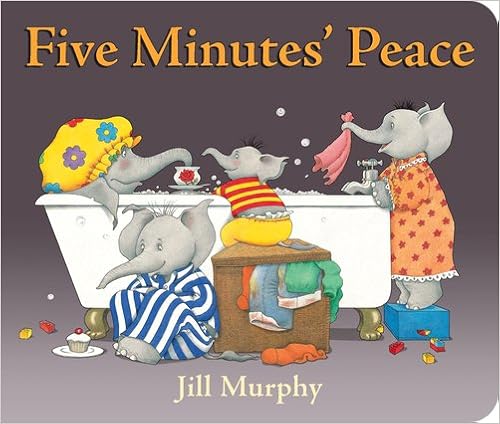
If you're like me, the answer is 'D' -- all of the above. When I lose my keys, the Internet is down at work, the latest text message carries with it a downturn in a friend or family member's health, and social media is broadcasting the latest in who is angry at whom, I feel like the momma elephant in the children's book Five Minutes Peace by Jill Murphy.


"The children were having breakfast. This was not a pleasant sight."

Murphy has this one right. I'm in the middle of reading a book Behind the Beautiful Forevers by Katherine Boo. It's a non-fiction story about life in a Mumbai undercity. Children are not having breakfast there, but they're not really considered the poor in India which makes me wonder how desperate do you have to be to be poor in India. In the meantime, down the street, folks are upset because a major coffeehouse has changed the design of their cups.

The children of the world are having (or not having) breakfast, and it is not a pleasant sight.

During all this morning hour, as in Murphy's book, everyone is vying for momma's or our attention: Look at me! Look at me! Look at me! Then, Can I? Can I? Can I? And, I'll add during this season: Buy me...Buy me...Buy me...

Dallas Willard writes: "We are immersed in birth-to-death and wall-to-wall 'noise' -- silent and not so silent" (The Divine Conspiracy 9). It's not just the morning hour, 24/7 we are "smothered in slogans" (ibid) and facing our own video thoughts.

All the momma wants in this children's book is five minutes of peace, and along with slowing down, five minutes of silence filled with peace helps me and others bring "truth, goodness, strength, and beauty into our lives" (Willard 10). Five minutes of stillness with God cuts through my first instinct to blame someone for "accidentally" picking up my keys (when I simply put them in a different place), cuts through the panic of how will I get my job done, cuts through the despair, cuts through sheer nonsense. God comes alongside and I stop scapegoating (blaming others), and I gain creativity and hope and wisdom. I can lift up my eyes and see someone else at the breakfast table other than myself. That will be the subject of a different post, but for now, for those who might be scared about 5 minutes with God, I leave you with this: God likes you; He loves you. He's like Mr. Rogers except hundreds upon hundreds times better.


Joining me on this journey of practice? Slowing down and 5 minutes of stillness with God.
Joining me reading? Pages 9 - 13 of The Divine Conspiracy. 


Friday, November 06, 2015

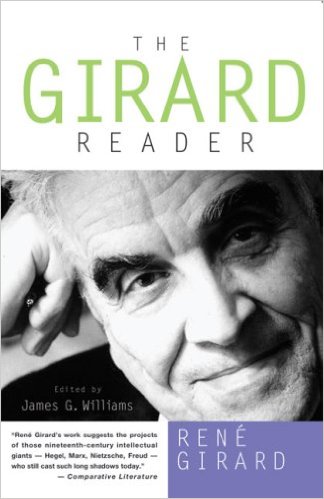
Learning Not to Blame Others -- RIP Rene Girard

Yesterday, my post wished Jeffrey Sachs a "Happy Birthday." Today's post wishes Rene Girard a peaceful rest. 


A college professor (at a state university) first introduced me to the writings of Girard. Although I was a Christ-follower, I didn't realize the lie in my life when it came to blaming others. The truth is this: because of Christ, I no longer need a scapegoat; I no longer need to blame others ("not as though I have attained"). Rene Girard taught me that. 

Girard had academic acclaim but his ideas proved problematic for some of his intellectual colleagues when he put his trust in Jesus Christ. For his critics, "One can only know about such theories and principles, and think about them in more or less clever ways," as Willard writes of "the current world of accepted knowledge" in The Divine Conspiracy (5). In today's culture, one shouldn't tie such theories to moral knowledge or God. 

But, according to those close to Girard, he not only taught what he believed, he lived into it as well. 


"RenΓ© taught us that to truly live is to stop scapegoating our enemies, and to stop justifying it in the name of God. Once at a conference, RenΓ© was asked what would happen if mimetic theory became wildly successful. He answered, “There would be no more scapegoating.”
To end scapegoating and to truly live we need to follow Jesus by turning away from violence and turning toward our neighbors, including those we call our enemies, in the spirit of love and nonviolence.
RenΓ© not only taught us that truth, he lived into it. I met him once at a conference for young Girardian scholars. I was struck by the fact that RenΓ© wasn’t interested in teaching us, or making sure we had his theory “right.” What he wanted more than anything was to talk with us. He wanted to learn about our lives and what interested us. He had a special humility about him – instead of taking glory for himself, he gave glory to others" (Adam Ericksen).

I don't have that special humility but I am on the slow track of practicing Christ-centered spiritual formation. To do so, this week, I'm practicing slowing down -- slowing down enough to let the Holy Spirit get a word in edge-wise when I'm about to scapegoat someone, to blame others. Join me if you care to do so. 

And, if you're a reader, I'm moving on to pages 3-8 in The Divine Conspiracy. 
If you REALLY like to read, here are some links to recent articles on Rene Girard: 
http://www.patheos.com/blogs/teachingnonviolentatonement/2015/11/in-memory-of-rene-girard-the-truth-about-life-and-death/

http://www.patheos.com/blogs/cosmostheinlost/2015/11/04/lux-aeterna-rene-girard-december-25-1923-nov-4-2015/

http://www.abc.net.au/religion/articles/2015/11/05/4346211.htm


Thursday, November 05, 2015

Happy Birthday, Jeffrey Sachs

I changed my mind about what I was going to write this morning when I read that today is Jeffrey Sachs's birthday (11/5/54). You may not know who he is. Don't feel bad; neither did I (and the rest of you can be aghast that we do not know the man considered to be the world's leading expert on economic development and the fight against poverty). 


That's okay. I may not know something that perhaps I should have known, but I'm happy to learn it now. I came across a speech Sachs gave this year at Columbia University (3/30/2015) when I did an Internet search for moral knowledge in U.S. universities. I was sure that Dallas Willard's information in his opening chapter of The Divine Conspiracy must have changed since 1997. After all, Willard cites Derek Bok's 1986-1987 "President's Report" (for Harvard). Bok concludes his report with this remark, "Despite the importance of moral development to the individual student and society, one cannot say that higher education has demonstrated a deep concern for the problem..." (qtd. by Willard 3). 

I know I promised to try to be brief. (I'm working on it.) The title of Sachs's speech was "What is a Moral University in the 21st Century?" and you can probably guess that Willard's information still holds true. Sachs acknowledges early on in his speech, "There are many who, quite understandably, would argue that we shouldn't enter the moral thicket." Many of my friends would look at me wondering why I would be surprised: Of course universities aren't involved with moral education anymore. But, read what Sachs said next: "Let's be pragmatic, they would say." Ohhhhh, there's quite a few of us that tend toward pragmatism. Let's be practical, we say. 

Later Sachs says, "Almost all of us are out of practice in moral reasoning. Moral reasoning...requires training, practice, and experience...We are mostly out of practice..." And, he concludes: "My message, colleagues, is that morality counts. It counts for our intellectual purposes; it counts for our souls." 

I can hear friends now: "Whose morality?" Sachs mentions Buddha, Aristotle and Jesus. I'm going with Jesus. As, I mentioned a couple of days ago, for many that requires "a fresh hearing for Jesus" free of the "stranglehold...that automatically shunts aside Jesus" (Willard, introduction).

I'm reading The Divine Conspiracy Chapter 1, "Entering the Eternal Kind of Life Now" -- sections "Life in the Dark" and "Rumors from the Intellectual Heights" 

I'm practicing slowing my steps down 1) so that I'm not rushing like a rat in a rat race and 2) so I can hopefully notice if I'm responding to moments in my day the way the world responds: practical, on the defense, watching out for myself, or if I'm responding in the love, goodness, and intelligence of Jesus.  

A link to Jeffrey Sachs's speech: http://jeffsachs.org/2015/04/2748/